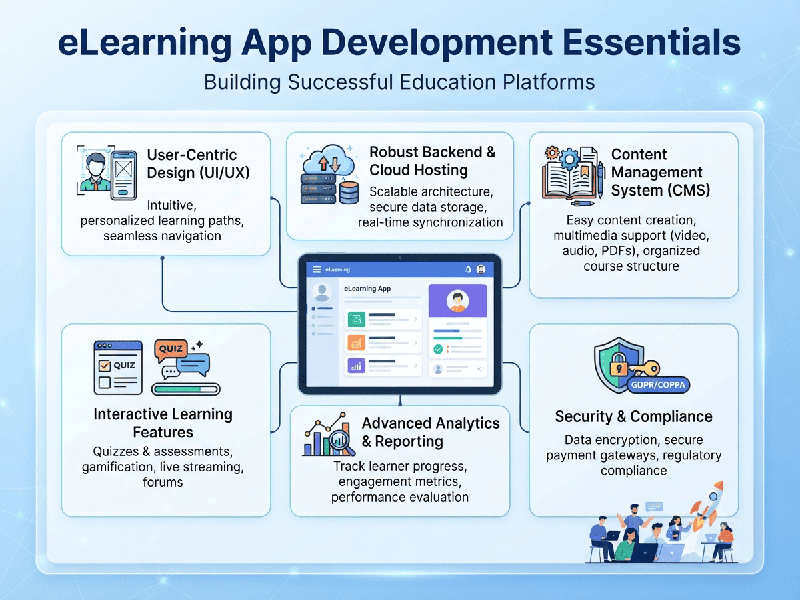
eLearning App Development Essentials
Developing a successful e-learning application in 2026
requires a balance of user-centric design, a scalable technical foundation, and
strict adherence to India’s evolving data privacy landscape.
1. Core Development Phases
- Discovery & Validation: Before coding, conduct market
research to identify gaps. Validate your concept through surveys or pilot
programs to ensure there is a clear demand for your specific niche (e.g.,
K-12, professional upskilling, or hobbyist training).
- MVP (Minimum Viable Product): Focus on core
functionality—such as user registration, basic content delivery
(video/text), and simple assessments—to gain early user feedback and
iterate quickly before full-scale development.
- Platform & Modality: Decide on your learning model
early (e.g., live classes, self-paced, or cohort-based) as this dictates
your entire content architecture and UX design.
2. Recommended Technology Stack
- Frontend: Use frameworks like React
or Angular for robust, responsive interfaces that work seamlessly
across mobile and desktop.
- Backend: Node.js with Express is
widely favored for scalable backends. For server-side logic, Python
(Django) is a common, reliable choice.
- Database: Use PostgreSQL for
relational data (user accounts, course structures) or MongoDB for
flexible, unstructured content formats.
- Cloud Infrastructure: Leverage AWS or Google
Cloud for hosting, content delivery networks (CDNs) for video
streaming, and scalable storage.
3. UX Design Best Practices
- Mobile-First & Consistent: Ensure a seamless experience
across devices. Navigation should be intuitive—if a "Next"
button is at the top right, keep it there consistently.
- Engagement & Gamification: Implement
"bite-sized" learning (micro-lessons) and use progress
indicators, badges, or leaderboards to maintain motivation.
- Accessibility: Adhere to universal design
principles (high-contrast colors, alt-text for images, and
keyboard-operable navigation) to ensure inclusivity.
4. Security & Compliance in India
Given India's Digital Personal Data Protection
(DPDP) Act, 2023, security is no longer optional—it is a legal mandate.
- Data Protection: You must practice data
minimization (collecting only what is necessary) and obtain verifiable
parental consent for users under 18.
- Authentication: Implement Multi-Factor
Authentication (MFA) and Role-Based Access Control (RBAC) to prevent
unauthorized access to sensitive student records.
- VAPT (Vulnerability Assessment
and Penetration Testing): Regularly test your app for risks like SQL injection or
broken authentication, especially if you handle payment gateways or exam
proctoring.
Compliance: Be transparent in your privacy policy about data usage and your breach notification protocols. Non-compliance can lead to significant penalties.