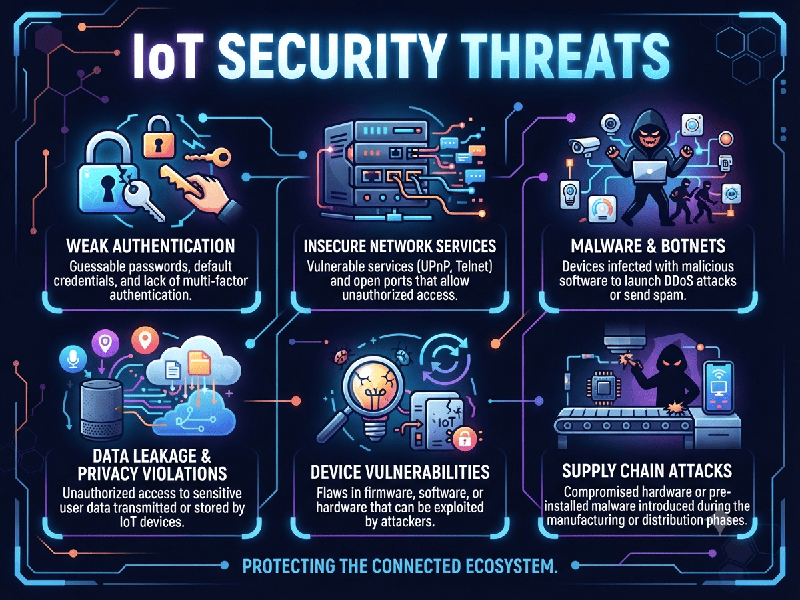
IoT Security Threats
The Internet of Things (IoT) landscape in 2026 faces
an escalating threat environment, driven by the mass proliferation of connected
devices and the increasing sophistication of cybercriminal tactics.
Top IoT Security Threats in 2026
- IoT Botnet Proliferation &
DDoS Attacks:
This remains the most prevalent threat. Attackers recruit millions of
vulnerable devices (routers, cameras, smart appliances) into massive
botnets to launch high-volume Distributed Denial-of-Service (DDoS)
attacks. Recent incidents in 2026 have seen botnets capable of generating
over 31 Tbps of traffic.
- AI-Powered Reconnaissance: Cybercriminals are increasingly
using AI to automate the discovery of vulnerable devices. These tools can
scan global IP ranges in real-time to identify and exploit unpatched
firmware or default credentials faster than human defenders can react.
- Supply Chain & Firmware
Compromise:
Threats often begin before a device is even deployed. "BadBox"
style attacks involve pre-installed malware on consumer electronics.
Furthermore, attackers frequently target the firmware update lifecycle,
planting persistent implants that are difficult to detect or remove.
- Shadow IoT & Visibility
Gaps: Many
organizations operate "Shadow IoT"—unauthorized or unmanaged
devices connected to the network without IT oversight. These devices often
lack security controls and provide an "invisible" entry point
for attackers to pivot into more sensitive enterprise systems.
- Exploitation of Legacy &
Unpatched Systems: A significant portion of IoT devices run on outdated operating
systems or abandoned firmware. Attackers actively target these known
vulnerabilities, as many manufacturers no longer provide security patches.
Recommended Best Practices
To mitigate these risks, organizations and users
should adopt a proactive security posture:
- Network Segmentation: Keep IoT devices on a separate
network (VLAN) from critical enterprise infrastructure to prevent lateral
movement if a device is compromised.
- Strict Credential Management: Immediately change all default
passwords to unique, strong credentials and enforce multi-factor
authentication (MFA) wherever supported.
- Automated Asset Visibility: Maintain a continuous inventory
of all connected devices. Use discovery tools to identify "Shadow
IoT" that may be operating outside of official security policies.
- Lifecycle & Patch
Management:
Implement a process for regular firmware updates. If a device no longer
receives security support from the manufacturer, it should be isolated or
retired.
- Zero Trust Architecture: Assume no device is inherently
safe. Use a zero-trust model to restrict communication between IoT devices
and other parts of your network to only what is strictly necessary.