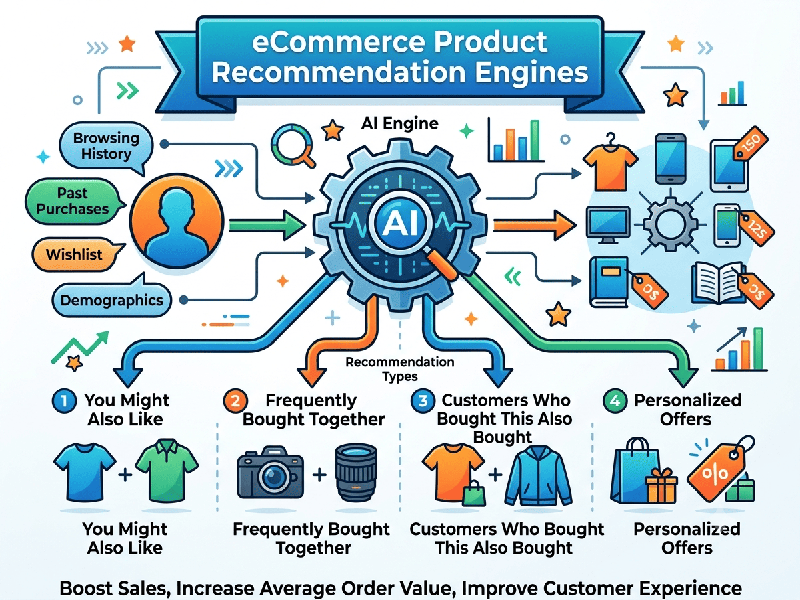
eCommerce Product Recommendation Engines
In 2026, eCommerce product recommendation engines have
evolved from simple "frequently bought together" widgets into AI-driven,
real-time, and predictive journey orchestrators. They are no longer just
merchandising tools; they are primary conversion and retention levers
integrated into an increasingly automated, "agentic" shopping
environment.
The 2026 Paradigm Shift
The fundamental change in 2026 is that personalization
is predictive and context-aware. Rather than reacting to past behavior
after the fact, systems now interpret intent as it unfolds in real-time,
often within highly compressed decision-making journeys.
1. From Reactive to Agentic Commerce
We are witnessing the rise of Agentic Commerce,
where AI shopping agents (acting on behalf of the consumer) interact with brand
websites.
- The Impact: These agents require
structured, detailed product data (Answer Engine Optimization or AEO) so
they can "read" product specs, compare them to a shopper’s
needs, and make purchase decisions automatically.
- The Challenge: Brands must now optimize their
product content not just for humans, but for the AI models that
"shop" on their behalf.
2. Advanced Technical Infrastructure
Modern recommendation engines now operate on a split
architecture:
- Offline Training: Massive, heavy computation
(training models, generating embeddings) happens asynchronously to keep
the live system fast.
- Real-time Serving: The system uses a streaming
layer (event streaming) to capture clicks, dwell time, and session
activity, combined with historical data, to serve sub-second,
hyper-relevant recommendations.
- Architectural Models: Most high-performing engines
now use "Wide & Deep" neural network architectures,
which combine the memorization of frequent patterns with the generalization
of complex embeddings, allowing them to understand the sequence and timing
of a shopper’s journey.
Key 2026 Trends to Watch
- Context Over Content: A product recommendation isn't
just about the item; it’s about the context. The same product is
recommended differently depending on whether the shopper is browsing
casually, comparing specific features, or ready to checkout.
- Compressed Journeys: Because AI assistants and
conversational search have shortened the time between product discovery
and decision, recommendation engines have fewer "touches" to
make an impact. Personalization must trigger almost instantly based on
minimal interaction signals.
- Confidence as Currency: Conversions in 2026 are driven
by consumer trust. Recommendations are most successful when they include
"confidence signals"—such as real-time inventory status,
verified reviews, or clear delivery windows—directly in the recommendation
module.
- Privacy-First Personalization: With shifting privacy
regulations and consumer expectations, "zero-party data"
(information shoppers explicitly share with you) is now a core input for
recommendation engines, moving away from reliance on third-party tracking.