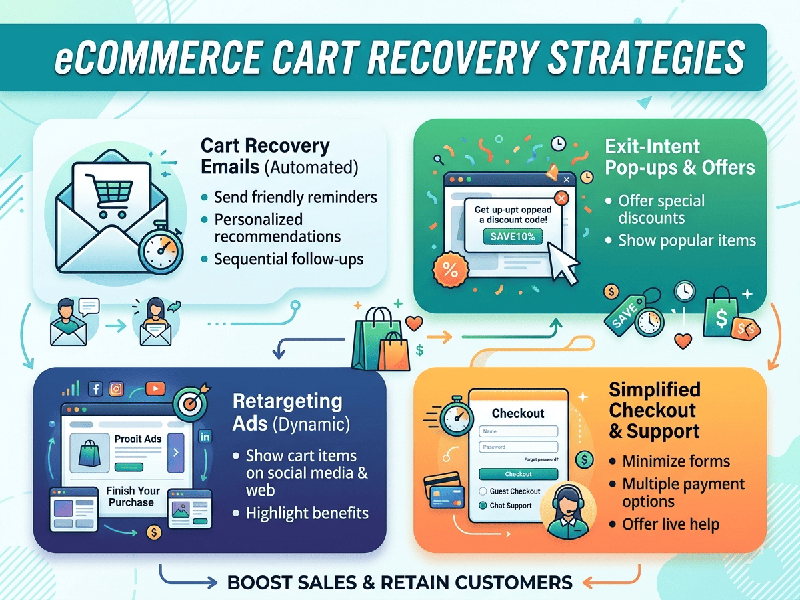
eCommerce Cart Recovery Strategies
Effective eCommerce cart recovery in 2026 relies on a
"prevent-then-recover" strategy that leverages real-time automation,
conversational channels like WhatsApp, and frictionless checkout experiences.
1. Conversational Recovery (The "New Standard")
In the Indian market, where mobile-first commerce dominates, WhatsApp
Business API is your most powerful tool.
- The 30-Minute Rule: Trigger a personalized WhatsApp
message within 30 minutes of abandonment. Since WhatsApp has a ~90% open
rate, this is vastly more effective than email.
- Two-Way Interaction: Use a shared inbox platform
that allows human agents or AI chatbots to handle queries (e.g., sizing,
shipping costs) instantly. This turns a "lost lead" into a
conversation.
- Media-Rich Reminders: Use WhatsApp’s multi-product
display to show exactly what they left behind, making the "Return to
Cart" action one click away.
2. Proactive Prevention (Before They Leave)
It is always cheaper to prevent abandonment than to recover
it.
- AI Intervention: Position an AI agent on your
checkout page. If a user idles for $>45$ seconds, have the bot
proactively offer help with shipping rates or product details.
- Checkout Speed: Implement a one-page
checkout with guest login as the default. Force-account creation is a
primary driver of abandonment.
- Transparency: Use API-integrated calculators
to show total costs (taxes + shipping) on the Product Detail Page (PDP).
Never surprise a customer with fees at the final step.
3. Technical Checklist for 2026
- Progress Indicators: Use a visual progress bar
(e.g., "Step 2 of 3") to reduce user anxiety.
- Trust Signals: Display SSL badges, money-back
guarantees, and curated, category-specific reviews (e.g., "4.8/5 for
Electronics") near the payment button.
- Data-Driven Retargeting: Connect your CRM to your
recovery platform to segment users. High-AOV (Average Order Value) carts
may warrant a more premium follow-up, while first-time visitors might need
more trust-building content.
- Frequency Capping: Do not spam. Limit exit-intent
popups to once per session to prevent user fatigue.