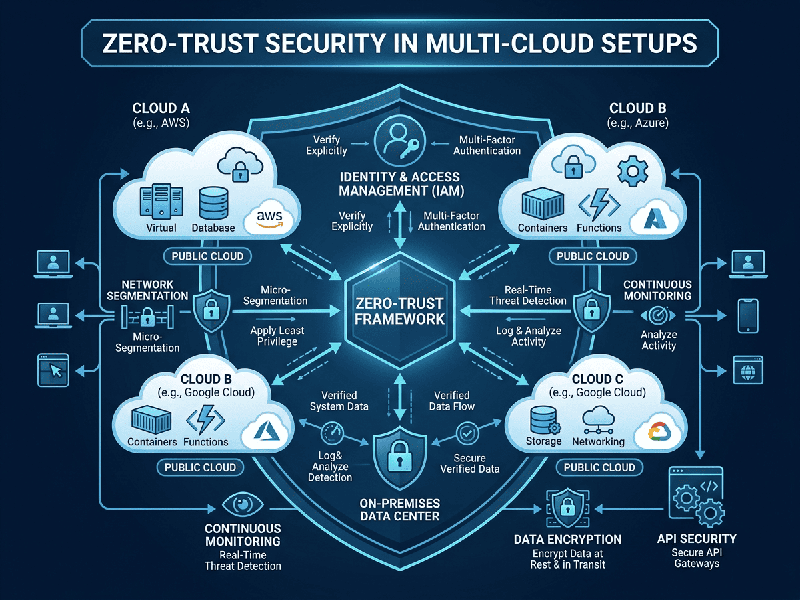
Zero-Trust Security in Multi-Cloud Setups
The traditional "castle-and-moat" security model is
obsolete. Multi-cloud setups—combining AWS, Azure, Google Cloud, and SaaS—have
dissolved the network perimeter. Zero-Trust Architecture (ZTA) replaces
implicit trust with continuous, context-aware verification.
1. The Core Strategy: "Never Trust, Always Verify"
Zero-Trust is not a single tool; it is a mindset centered on
three technical mandates:
- Assume Breach: Operate as if attackers are
already inside your AWS or Azure VPCs. Focus on containment rather than
just perimeter defense.
- Verify Explicitly: Every request must be
authenticated and authorized based on Identity, Device Posture,
and Context (time, location, and risk score).
- Least Privilege: Grant access only to the
specific resource needed, for the minimum time required (Just-In-Time
access).
2. Identity as the New Perimeter
In multi-cloud, the "network" is irrelevant because
your data lives everywhere. Identity & Access Management (IAM) becomes
your primary security boundary.
- Unified Identity Provider (IdP): Use a central IdP (like Okta,
Azure AD, or Google Cloud Identity) to provide Single Sign-On (SSO)
across all clouds.
- Phishing-Resistant MFA: Move beyond SMS codes to
hardware keys (FIDO2) or biometric passkeys.
- Conditional Access Policies: Automatically block access if a
user logs in from an unusual location (e.g., a new country) or an
unmanaged device that lacks the latest security patches.
3. Micro-Segmentation & East-West Traffic
Traditional firewalls stop "North-South" traffic
(entering/leaving the cloud). Zero-Trust focuses on "East-West"
traffic (service-to-service communication within the cloud).
- Micro-Segmentation: Divide your cloud workloads
into small, isolated zones. A compromised web server in your Azure
environment should not be able to "talk" to your database in AWS
unless explicitly allowed.
- Service Mesh (mTLS): Use tools like Istio or Linkerd
to enforce mutual TLS (mTLS). This ensures that every microservice
verifies the identity of every other microservice before exchanging data.
4. Zero-Trust Network Access (ZTNA)
ZTNA is the modern replacement for the traditional VPN.
- Application-Level Access: Unlike a VPN, which gives a
user access to the entire network, ZTNA connects users only to the
specific application they are authorized to use.
- Dark Infrastructure: ZTNA hides your applications
from the public internet. If a user isn't authenticated, the application's
IP address is essentially "invisible" to scanners and bots.
5. Continuous Posture & Compliance-as-Code
Multi-cloud environments change in milliseconds. Manual
security checks can't keep up.
- CSPM (Cloud Security Posture
Management):
Use automated tools to scan for "security drift" (e.g., an S3
bucket accidentally marked "Public" or a missing encryption
key).
- AI-Driven Analytics: In 2026, AI models monitor API
traffic in real-time. If an admin account suddenly starts exporting
massive amounts of data at 3:00 AM, the system can autonomously revoke the
session.