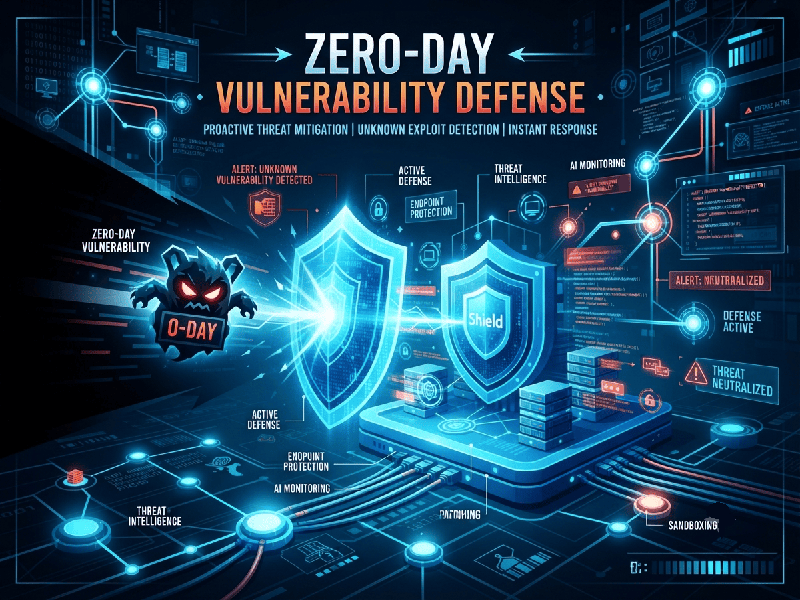
Zero-Day Vulnerability Defense
Defending against zero-day vulnerabilities—flaws
that are exploited before a vendor or developer knows about them or has
released a patch—requires a shift from preventative static defense to adaptive
runtime resilience. Because traditional signature-based tools (like basic
antivirus or static vulnerability scanners) are blind to unknown flaws, modern
defense relies on behavior, architecture, and containment.
1. Core Pillars of Zero-Day Defense
- Behavioral & Heuristic
Runtime Monitoring:
Instead of matching file signatures, modern Endpoint
Detection and Response (EDR) and Extended Detection and Response (XDR) tools
monitor system calls, process memory, and application behavior. If a standard
program suddenly attempts unauthorized memory injection, privilege escalation,
or unexpected network outbound calls, runtime controls block it instantly.
- Enforce Zero Trust Architecture
(ZTA):
Assume networks and applications are already
compromised. Under a "never trust, always verify" model, every
microservice call, API request, and user session must undergo continuous
authentication and authorization. This drastically limits an attacker's ability
to move laterally even if a zero-day grants them initial entry.
- Strict Network
Micro-Segmentation:
Isolate critical workloads, databases, and internal
infrastructure into tightly controlled zones. If an adversary exploits a
zero-day in a public-facing web server, segmentation prevents them from
pivoting easily to core enterprise databases or domain controllers.
- Adopting the Principle of Least
Privilege (PoLP):
Strip away permanent administrative rights. Utilize
Just-In-Time (JIT) access mechanisms so that if an application or user account
is hijacked via an exploit, the damage is constrained by minimal default
permissions.
2. Application & Infrastructure Hardening
- Memory Safety and Modern
Toolchains:
Many zero-days target memory corruption
vulnerabilities (such as buffer overflows). Enforce modern compiler-level
mitigations like Address Space Layout Randomization (ASLR), Data Execution
Prevention (DEP), and memory-safe coding languages where feasible.
- Attack Surface Reduction (ASR):
Minimize exposure by disabling unused services,
closing redundant ports, removing default accounts, and deploying minimal,
hardened container images (e.g., distroless containers) that lack shell
utilities or unnecessary binaries.
- Web Application Firewalls (WAF)
& Runtime Application Self-Protection (RASP):
Deploy advanced WAFs and RASP solutions that analyze
incoming application traffic and block suspicious structural payloads (such as
unexpected object injections or command executions) before they interact with
underlying code.
3. Incident Response and Agility
- Accelerated Patch Propagation:
While zero-days lack patches initially, vendors often
rush out emergency fixes ("hotpatches" or "day-one
patches") shortly after discovery. Organizations with automated,
streamlined patch-deployment pipelines drastically narrow their window of
exposure.
- Threat Intelligence Integration:
Continuously feed global threat intelligence feeds,
dark web chatter monitors, and early warning systems into your security
operations center (SOC) to identify active exploitation campaigns in the wild
before they hit your perimeter.