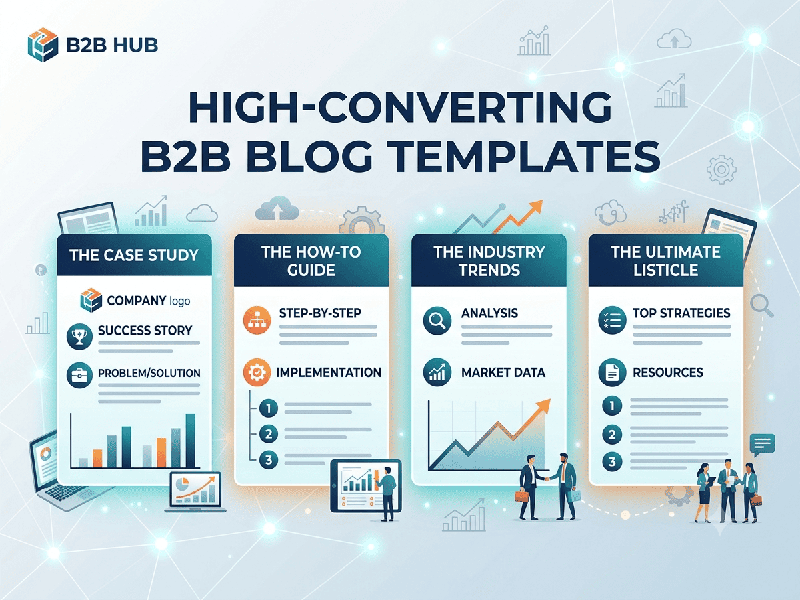
High-Converting B2B Blog Templates
High-converting B2B blog posts require a clear
structure that guides business decision-makers from problem awareness to
actionable solutions and direct conversion paths.
Below are three high-converting B2B blog post
templates tailored for distinct search intents, along with strategic conversion
placement principles.
1. The "Problem–Agitate–Solution" (PAS)
Template
Best for: Educational, middle-of-funnel topics targeting buyers
experiencing specific pain points.
- Catchy, Benefit-Driven Title: How to [Solve Specific Pain
Point] Without [Common Drawback/Cost]
- Hook & Problem Definition
(100–150 words):
State the industry problem directly. Validate the reader's frustration
with specific data or real-world scenarios.
- Agitation & Hidden Costs: Detail why existing workarounds
fail and quantify the impact of ignoring the problem (e.g., wasted budget,
lost efficiency, security risks).
- In-Line Lead Magnet (CTA 1): High-value downloadable asset
(e.g., checklist, template, or benchmark report) tied directly to the pain
point.
- The Framework / Solution (3–4
Main Sections):
o Step/Strategy 1: Concrete action item + visual
diagram/screenshot.
o Step/Strategy 2: Best practices and implementation
traps to avoid.
o Step/Strategy 3: Advanced optimization tips.
- Proof Point / Brief Case Study: Highlight how a customer or
industry peer resolved this exact issue using your framework/product.
- Final Call-to-Action (CTA 2): Primary conversion path (e.g.,
"Schedule a Demo," "Start Free Trial," or "Talk
to an Specialist").
2. The Comprehensive Tool / Solution Comparison
Template
Best for: Bottom-of-funnel buyers actively evaluating products, vendor
alternatives, or software stacks.
- Intent-Focused Title: Top [Number] [Category] Tools
for [Target Audience] in [Year]
- Executive Summary / Quick
Recommendation Table: Place a key takeaway table immediately below the introduction for
fast-scanning decision-makers.
o Columns: Tool Name | Best For | Key
Differentiator | Pricing Starting At
- Evaluation Criteria: Briefly outline how you
evaluated the options (e.g., scalability, integration capabilities, ROI,
support).
- Itemized Solution Analysis
(Repeat for each option):
o Overview: 1–2 sentence summary of core
positioning.
o Key Capabilities: 3–4 bullet points focusing on
enterprise capabilities.
o Pros & Cons: Direct, objective appraisal.
o Ideal User: Specific team size, industry, or use
case.
- Your Solution Showcase
(Mid-Article Spotlight): Highlight your product as the natural fit for the
primary target audience without sounding overly sales-driven. Include
specific feature callouts and user review quotes.
- Decision Matrix / Verdict
Section:
Summary of which tool to choose based on specific enterprise requirements.
- Closing CTA: Direct path to a product demo,
ROI calculator, or personalized trial.
3. The Definitive "How-To" Strategy Guide
Template
Best for: Top-of-funnel thought leadership and search engine traffic
targeting strategic initiatives.
- Actionable Title: The Complete Guide to [Industry
Process/Strategy] [Current Year]
- Key Takeaways / Table of
Contents: Jump
links and a 3-bullet summary for executive readers.
- Why [Topic] Matters Now: Contextualize the strategy with
industry shifts, market trends, or regulatory changes.
- Step-by-Step Execution Plan:
o Phase 1: Preparation & Strategy
Alignment
o Phase 2: Execution & Resource
Allocation
o Phase 3: Measurement &
Optimization (Key Metrics/KPIs)
- Tooling & Tech Stack
Requirements:
List necessary software categories or integrations to execute the strategy
effectively.
- Interactive / Native CTA: Embedded ROI calculator,
interactive assessment tool, or audit request form.
- Summary & Final Action Step: Concise wrap-up emphasizing
speed-to-value and offering expert consultation.