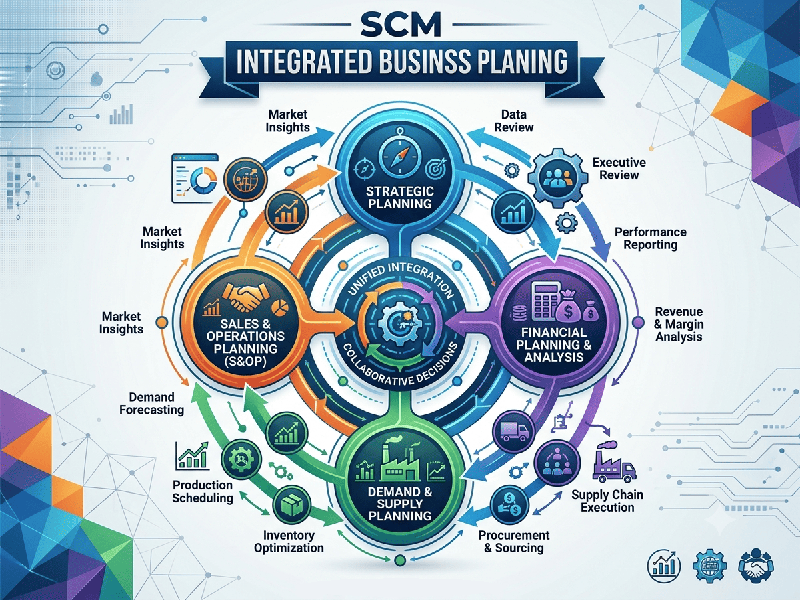
SCM Integrated Business Planning
Integrated Business Planning (IBP) in Supply Chain Management is an
enterprise-wide planning process that connects operational supply chain
activities with corporate financial goals, strategic planning, product
lifecycles, and commercial demand.
Key Pillars of SCM Integrated Business Planning
1.
Product & Portfolio Management: Evaluates the product lifecycle, upcoming launches,
phase-outs, and R&D pipelines to model capacity impact before
commercialization.
2.
Demand Planning: Develops an unconstrained baseline forecast incorporating market
intelligence, trade promotions, price elasticity, and macroeconomic variables.
3.
Supply Planning: Evaluates manufacturing constraints, raw material procurement, logistics
network capacity, and inventory buffers to optimize resource deployment.
4.
Financial Reconciliation: Translates unit-based demand and supply plans directly into
financial projections (revenue, gross margin, EBITDA, cash flow, and working
capital requirements).
5. Executive Review: Brings senior leadership together monthly to approve the final operating model, resolve cross-departmental bottlenecks, and evaluate strategic gap-closing options.
1.Product & Portfolio Review:
Evaluate launch timelines, promotional schedules, and
product obsolescence. Output: Updated product pipeline assumptions impacting
overall capacity.
2.Demand Review:
Synthesize statistical forecasting with sales input,
marketing campaigns, and customer signals. Output: Consensus unconstrained
demand plan.
3.Supply & Capacity Review:
Simulate supply network constraints against the demand
plan across procurement, plant scheduling, and distribution. Output:
Constrained supply plan with identified bottleneck scenarios.
4.Integrated Financial Reconciliation:
Run value-at-risk analysis and cost simulations to
align operational metrics directly with the corporate financial ledger. Output:
Scenario options for executive decision-making.
5.Management Business Review (MBR):
Executive sign-off on the single operating plan,
reallocation of capital resources, and strategic alignment for unresolved gaps.