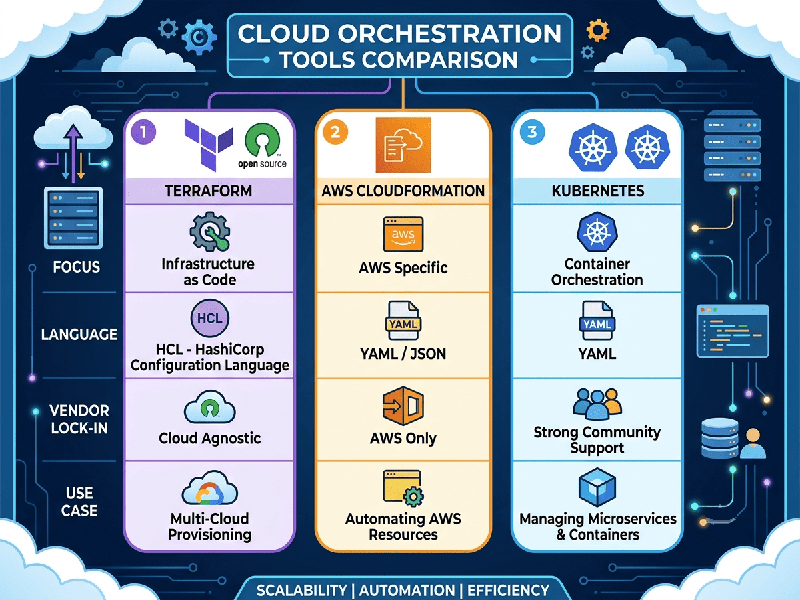
Cloud Orchestration Tools Compared
Cloud orchestration tools fall into distinct
operational categories depending on whether you are orchestrating underlying
infrastructure, containerized applications, system configurations, or
end-to-end workflows.
Tool Overviews
1. HashiCorp Terraform
- Best for: Multi-cloud infrastructure
provisioning.
- Key Strengths: Provider ecosystem covering
AWS, Azure, GCP, and custom APIs. Declarative HCL syntax makes dry-runs
(terraform plan) accurate.
- Limitations: Requires careful state
management (locking, backends) in team environments.
2. Ansible
- Best for: Post-provisioning
configuration, software installs, and network orchestration.
- Key Strengths: Agentless (uses SSH/WinRM). Low
barrier to entry using simple YAML Playbooks.
- Limitations: Slower performance on
large-scale infrastructure compared to agent-based systems; not optimized
for container management.
3. Kubernetes (K8s)
- Best for: Automating deployment, scaling,
and management of containerized applications.
- Key Strengths: Self-healing workloads,
auto-scaling, fine-grained service mesh routing, and declarative state
control.
- Limitations: High operational complexity and
steep learning curve for cluster management.
4. AWS CloudFormation
- Best for: Native provisioning within the
AWS ecosystem.
- Key Strengths: Zero state-file maintenance;
seamless integration with AWS IAM, drift detection, and automated
rollbacks.
- Limitations: Vendor lock-in; multi-cloud
setups require separate tooling like Terraform.