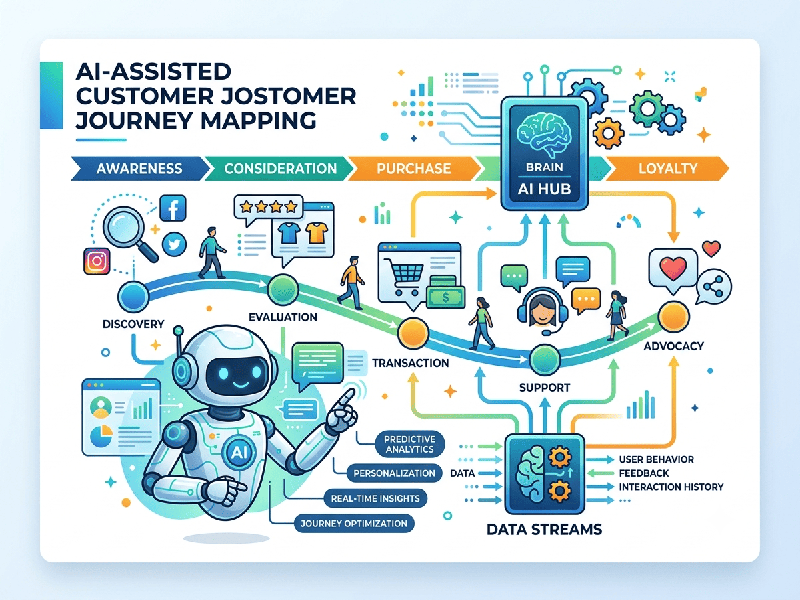
AI-Assisted Customer Journey Mapping
AI-Assisted Customer Journey Mapping replaces static, manually drawn
journey maps with dynamic, real-time data visualisations. Instead of relying on
periodic surveys and assumptions, artificial intelligence continuously ingests
interactions across multiple touchpoints to map, predict, and optimise how
customers engage with a brand.
1. Core Capabilities of AI in Journey Mapping
1.
Unified Data Aggregation: AI connects data silos (social media, website clicks,
support tickets, email opens, and point-of-sale transactions) into a single
customer profile.
2.
Dynamic Persona Creation: Machine learning groups users based on live behavior,
sentiment, and intent rather than just static demographics.
3.
Sentiment & Emotion Analysis: Natural Language Processing (NLP) reviews support chats and
feedback to highlight friction or frustration points along the path.
4.
Predictive Analytics: Algorithms forecast next likely actions (e.g., cart abandonment, churn
risk, or readiness to upgrade).
5.
Real-Time Personalization: Triggers personalized content, offers, or automated
follow-ups based on where a user is in the journey.
2. Step-by-Step Implementation Framework
1.
Define Core Business Objectives: Identify what you are optimizing for (e.g., reducing
onboarding friction, boosting conversions, or cutting churn).
2.
Consolidate Customer Touchpoints: Connect APIs from web analytics (Google Analytics, Mixpanel),
CRM platforms (Salesforce, HubSpot), and customer support platforms (Zendesk,
Intercom).
3.
Run AI Behavioral Segmentation: Feed aggregated data to unsupervised learning models to
identify distinct paths users take.
4.
Identify Drop-off & Friction Points: Use AI heatmaps, funnel analytics,
and NLP to find where users get stuck.
5.
Automate Orchestration & Interventions: Set up automated triggers (e.g., AI
chatbot prompts, personalized email offers) when a user exhibits churn
behavior.
6.
Iterate Continuously: Treat the AI journey map as a continuous diagnostic dashboard rather
than a one-time project.