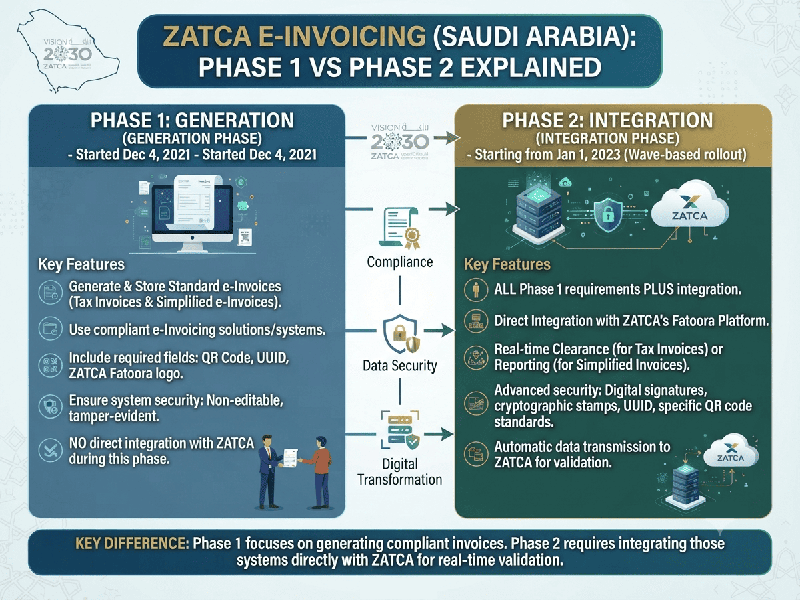
ZATCA E-Invoicing (Saudi Arabia): Phase 1 vs Phase 2 Explained
Saudi Arabia’s e-invoicing mandate—known as Fatoora
and enforced by the Zakat, Tax and Customs Authority (ZATCA)—requires
all VAT-registered businesses in the Kingdom to replace paper and unstructured
PDF invoices with structured electronic invoices.
The rollout is divided into two distinct phases: Phase
1 (Generation) and Phase 2 (Integration).
Phase 1: The Generation Phase (Implemented December 4,
2021)
Phase 1 focused on eliminating handwritten invoices
and basic word-processor/spreadsheet templates, requiring businesses to
generate and store invoices digitally using a compliant software solution.
Applicability: Mandatory for all VAT-registered resident taxpayers
in Saudi Arabia (excluding non-resident taxable persons).
Core Requirements:
Electronic Generation: Invoices, credit notes, and debit
notes must be generated electronically using a ZATCA-compliant billing system.
Mandatory Fields: Invoices must contain specific required fields,
including the seller’s VAT registration number, invoice issue date/time,
sequential invoice number, item descriptions, VAT rate/amount, and the buyer's
VAT number (for B2B transactions).
QR Code (Simplified Invoices): For B2C (Simplified Tax Invoices),
a basic TLV-encoded (Tag-Length-Value) QR code containing 5 core fields (Seller
Name, VAT Number, Timestamp, Invoice Total, and VAT Total) must be printed on
the invoice.
Prohibited Functions: The software must block uncontrolled
invoice alteration, deletion, backdating, and manual resets of invoice sequence
numbers.
No ZATCA Connection Required: In Phase 1, invoices do not need to
be transmitted to ZATCA in real time; they are simply generated, issued to the
customer, and archived locally.
Phase 2: The Integration Phase (Rolled Out in Waves
Since January 1, 2023)
Phase 2 connects taxpayers' accounting/ERP systems
directly to ZATCA’s central Fatoora platform via API, introducing
real-time validation and cryptographic security.
Applicability: Implemented in waves based on annual taxable revenue.
ZATCA notifies each taxpayer group at least 6 months before their
mandatory integration deadline. (By 2025–2026, ZATCA has expanded waves down to
smaller revenue brackets—covering businesses with annual revenues exceeding SAR
1.5M, SAR 1M, SAR 750K, and lower thresholds in subsequent waves).
Core Requirements:
API Integration with Fatoora: Taxpayers must onboard their
e-invoicing generation units (EGS) with ZATCA to obtain a Cryptographic
Stamp Identifier (CSID).
Standard XML / PDF-A/3 Format: Invoices must be generated in a
structured UBL 2.1 XML format (or PDF/A-3 with the XML file embedded
inside).
Real-Time Clearance (B2B Standard Tax Invoices): Before a B2B invoice can be legally
shared with the buyer, it must be sent to ZATCA via API for real-time
validation. ZATCA verifies the data, applies its official cryptographic stamp,
and returns the cleared invoice.
24-Hour Reporting (B2C Simplified Tax Invoices): B2C invoices can be issued
immediately to the consumer at the point of sale, but must be reported to
ZATCA’s platform within 24 hours of issuance.
Advanced Security & Tamper-Resistance: Every invoice must include a UUID
(Universally Unique Identifier), an Invoice Counter Value (ICV), a Previous
Invoice Hash (PIH) linking it to the prior invoice (similar to blockchain
chaining), and a Cryptographic Stamp generated by the taxpayer's device.
Expanded QR Code: Both B2B and B2C invoices require a 9-field QR code
that embeds the cryptographic stamp, invoice hash, and ZATCA's public key.