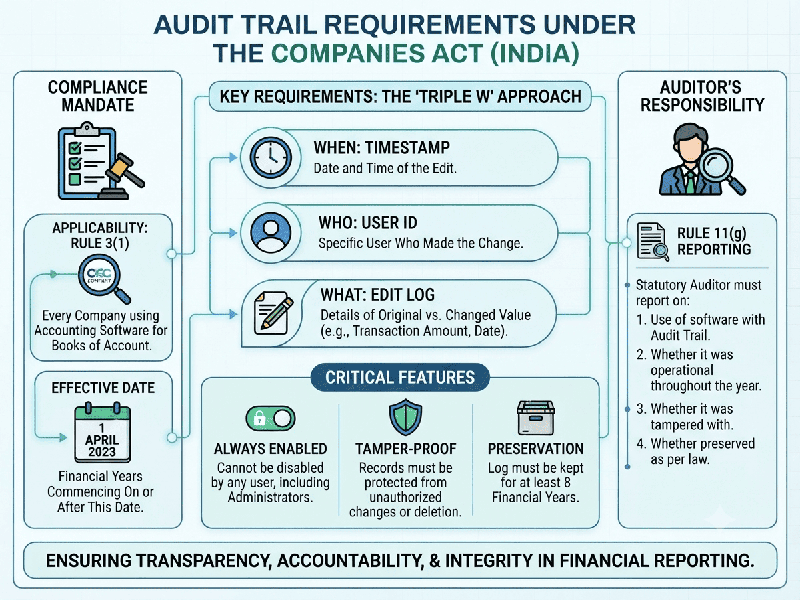
Audit Trail Requirements Under the Companies Act
Under the Companies Act, 2013 (India), any
company that uses accounting software to maintain its books of account must
ensure that the software maintains a mandatory, tamper-proof audit trail
(edit log).
Introduced by the Ministry of Corporate Affairs (MCA)
through amendments to the Companies (Accounts) Rules, 2014 and the Companies
(Audit and Auditors) Rules, 2014, this regulation applies to all financial
years commencing on or after April 1, 2023.
Legal Framework & Applicability
Proviso to Rule 3(1) of the Companies (Accounts)
Rules, 2014: Places
the statutory responsibility on company management to use only
accounting software that records an audit trail of every transaction, creates
an edit log of every change made in the books of account, and cannot be
disabled.
Rule 11(g) of the Companies (Audit and Auditors)
Rules, 2014:
Mandates statutory auditors to specifically verify and report in their
audit report whether the company used compliant software, whether the audit
trail operated throughout the year without tampering, and whether it was
preserved according to statutory retention rules.
Who Must Comply?
All registered companies under the Companies Act,
2013—including private limited companies, public companies, One Person
Companies (OPCs), small companies, Section 8 (non-profit) companies, and Nidhi
companies.
Foreign companies operating in India (such as branch or liaison
offices) with respect to their Indian books of account.
Outsourced Accounting: If accounting is outsourced to a
third-party service provider using their own software, the requirement still
applies to that software.
Exception: Entities that maintain their books of account entirely
manually (without accounting software) are outside the scope of this
requirement. (Note: Limited Liability Partnerships (LLPs) are governed by the
LLP Act, not the Companies Act, and are currently exempt unless specifically
notified).
Core Technical & Functional Requirements
To comply with the MCA mandate and the ICAI
Implementation Guide, a company’s accounting software and IT environment
must meet the following standards:
Transaction-Level Logging: The software must record an audit
trail for each and every transaction (creation, modification, or
deletion) affecting the books of account, including sub-ledgers (such as
inventory, payroll, or fixed asset registers) if they form part of the books of
account.
Mandatory Edit Log Details: Every log entry must capture:
Who made the change (User ID).
When the change was made (accurate date and timestamp).
What data was changed (identifying both the original pre-edit
values and the modified values).
Non-Disableable & Continuous Operation: The audit trail feature must remain
enabled throughout the entire financial year. Neither administrators nor
regular users should be able to switch it off or pause it.
Database-Level Protection: For ERP systems and custom software
backed by databases (like SQL or Oracle), the audit trail must also be enabled
at the database level so that direct back-end alterations bypassing the
application interface are logged.
Immutability & Access Control: The edit logs themselves must be
protected against deletion, alteration, or tampering. Access to view or export
audit trail logs must be strictly restricted to authorized personnel.
8-Year Record Retention: Under Section 128(5) of the
Companies Act, 2013, books of account must be preserved in good order for at
least 8 financial years. Because the audit trail forms an integral part
of electronic books of account, the edit logs must also be retained and
retrievable for a minimum of 8 years.