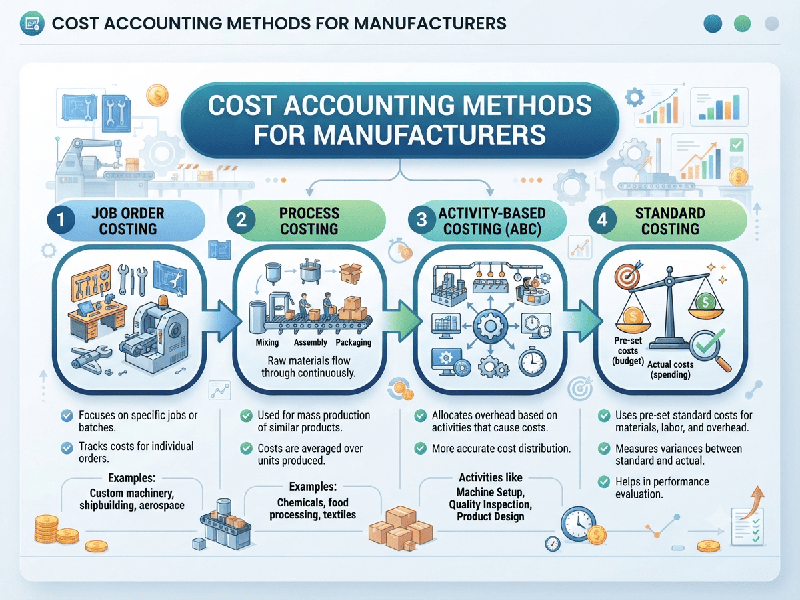
Cost Accounting Methods for Manufacturers
For manufacturers, cost accounting is the foundation
of accurate inventory valuation, margin analysis, and pricing strategy. Because
production environments vary wildly—from custom machinery fabrication to
continuous chemical processing—manufacturers use different cost accounting
methods to track direct materials, direct labor, and manufacturing overhead.
Core Cost Accounting Methods
1. Job Order Costing
How it works: Costs are accumulated and assigned to a specific
"job," batch, or custom-ordered product. Each job has a unique bill
of materials and routing sheet.
Best used for: Low-volume, custom, or made-to-order manufacturing (e.g.,
specialized industrial machinery, aerospace components, custom furniture).
Key advantage: Provides precise visibility into the exact profitability of
every individual project or client order.
2. Process Costing
How it works: Production costs are averaged across large volumes of
identical, continuous units passing through sequential departments or
processes. Total costs for a period are divided by total units produced to find
a per-unit cost.
Best used for: Mass-production, continuous-flow, or homogeneous
manufacturing (e.g., chemicals, food and beverage processing, petroleum
refining, textiles).
Key advantage: Highly efficient for high-volume environments where tracking
individual units is impractical.
3. Batch Costing
How it works: A hybrid between job and process costing. Costs are tracked
for an entire batch or lot of identical items rather than a single unit or a
continuous stream.
Best used for: Medium-volume manufacturing where goods are produced in
distinct runs (e.g., pharmaceutical drug manufacturing, clothing production in
specific sizes and colors, electronics assembly).
Key advantage: Allows manufacturers to measure the cost-efficiency of
specific production runs and tooling setups.
4. Operation Costing
How it works: A hybrid method applied to goods that undergo identical
conversion processes (like process costing) but use customized materials or
finishing steps (like job costing). Conversion costs are grouped by operation,
while material costs are tracked by job.
Best used for: Assembly-line environments where basic components are
standardized, but final configuration or styling varies (e.g., automotive
interior assembly, custom apparel finishing).
Key advantage: Balances the simplicity of process costing with the
flexibility required for product variants.
5. Activity-Based Costing (ABC)
How it works: Overhead costs are assigned to specific manufacturing
activities (e.g., machine setups, quality inspections, material handling)
rather than using a blanket allocation rate like machine hours or direct labor
hours. Costs are then traced to products based on their actual consumption of
those activities.
Best used for: Complex manufacturing facilities producing diverse product
lines with varying overhead demands.
Key advantage: Eliminates cross-subsidization, revealing the true
profitability of complex, low-volume products versus simple, high-volume ones.
Cost Measurement Systems: Actual vs. Standard
Regardless of the tracking method chosen,
manufacturers apply one of two valuation approaches:
Actual Costing: Records costs based on historical, real-time expenditures
for materials, labor, and overhead. While accurate, it delays financial
reporting until all actual invoices and utility bills are settled.
Standard Costing: Uses predetermined (budgeted) costs for materials,
labor, and overhead. At the end of the period, management analyzes variances
(the difference between standard and actual costs) to identify operational
inefficiencies, waste, or price fluctuations.