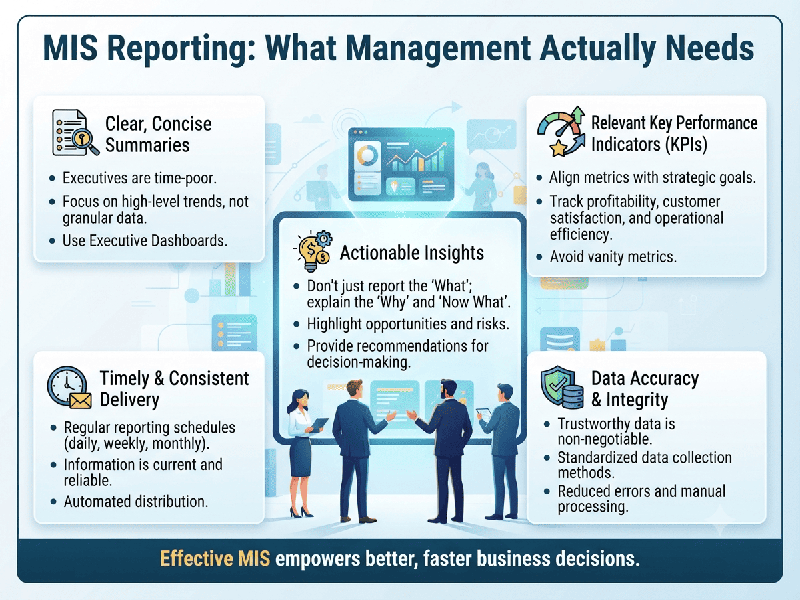
MIS Reporting: What Management Actually Needs
Management Information Systems (MIS) reporting often
fails because it focuses on what the system can generate rather than
what decision-makers actually need to run the business. Effective MIS
reporting bridges the gap between raw operational data and executive action.
What Management Actually Needs
Management does not need more data; they need clarity,
context, and foresight. Here is what leadership actually looks for in an
MIS report:
1. Key Performance Indicators (KPIs) Tied to Strategy
What it is: A curated set of metrics that directly reflect the company’s
core strategic goals (e.g., customer acquisition cost, net revenue retention,
operational uptime, cash runway).
Why it matters: Executives don't have time to sift through dozens of vanity
metrics. They need to know instantly if the business is winning or losing
against its stated targets.
2. Exception Reporting (Focus on the Outliers)
What it is: Reports that highlight performance significantly above or
below expected baselines, rather than listing routine, on-track operations.
Why it matters: Management’s time is a scarce resource. MIS should filter
out the noise and draw immediate attention to bottlenecks, risks, or unexpected
windfalls that require intervention.
3. Context, Trends, and Variance (Not Just Numbers)
What it is: Data presented with historical comparisons
(Month-over-Month, Year-over-Year), budget-versus-actual variances, and
industry benchmarks.
Why it matters: A single number like "Revenue is $2M" is
meaningless without context. Knowing that revenue is $2M, which is 15% below
budget due to a supply chain delay, enables immediate problem-solving.
4. Actionable Insights, Not Just Post-Mortems
What it is: Forward-looking projections, scenario analyses, and
root-cause explanations accompanying the data.
Why it matters: Traditional reports tell management what happened
last month. Effective MIS helps them understand why it happened and what
they should do about it next week.