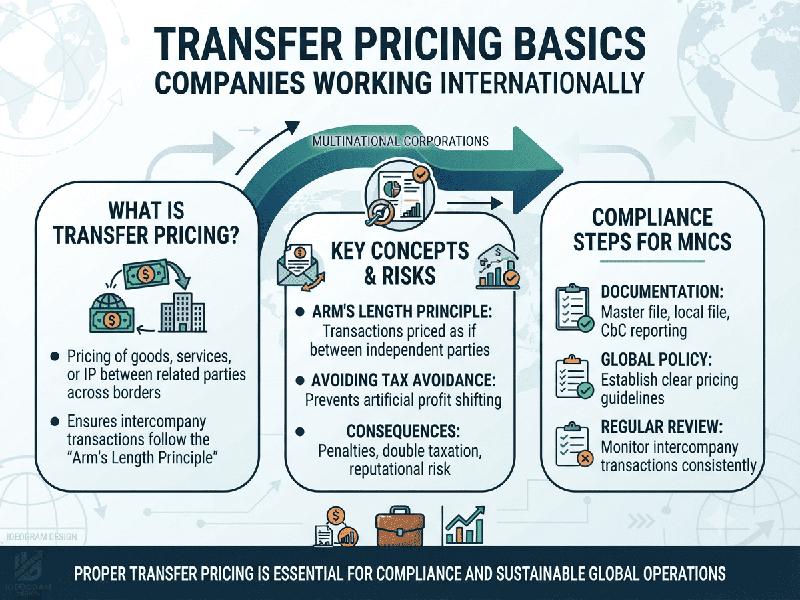
Transfer Pricing Basics for Companies Working Internationally
For multinational enterprises, transfer pricing
refers to the setting of prices for transactions between related legal
entities—such as a parent company and its foreign subsidiaries, or sister
companies operating in different countries. These transactions can involve
tangible goods, services, intellectual property (IP), or financial loans.
Because tax rates and regulations vary across borders,
transfer pricing is one of the most heavily scrutinized areas in international
tax compliance. Tax authorities closely monitor these transactions to ensure
companies do not artificially shift profits to low-tax jurisdictions to
minimize their global tax burden.
The Core Principle: The Arm's Length Principle
The global standard for transfer pricing—established
by the Organisation for Economic Co-operation and Development (OECD) and
adopted by tax authorities worldwide—is the Arm's Length Principle.
What it means: Transactions between related entities must be priced as if
the two parties were completely independent organizations operating in a free
market under identical circumstances.
Why it matters: If a US parent company sells software licenses to its Irish
subsidiary, the price charged must reflect what an unrelated third-party buyer
would pay for those same licenses. If the price is artificially inflated or
deflated, tax authorities can reallocate profits and levy heavy penalties.
Recognized Transfer Pricing Methods
To determine an arm's length price, tax regulations
recognize several standard methods. Companies must select the method that best
fits the specific nature of the transaction.
1. Comparable Uncontrolled Price (CUP) Method
How it works: Compares the price charged in a controlled transaction
(between related parties) with the price charged in a comparable uncontrolled
transaction (between independent parties).
Best used for: Commodities, standardized goods, or simple financial loans
where exact market comparables are readily available.
2. Resale Price Method (RPM)
How it works: Takes the price at which a product is resold by an affiliate
to an independent third party and subtracts an appropriate gross margin
(representing the reseller's costs and profit) to work backward to the transfer
price.
Best used for: Distribution and marketing operations where a company buys
finished goods from a related entity and resells them locally.
3. Cost Plus Method
How it works: Calculates the supplier's actual cost of producing the goods
or providing the service and adds an appropriate profit markup based on
comparable independent transactions.
Best used for: Contract manufacturing, shared service centers, or contract
research and development (R&D).
4. Transactional Net Margin Method (TNMM)
How it works: Examines the net profit margin relative to an appropriate
base (such as costs, sales, or assets) that a taxpayer realizes in a controlled
transaction, compared to margins earned by independent companies in similar
operations.
Best used for: Complex operating models where gross margin data is
unreliable, or for service providers and routine distributors.
5. Profit Split Method
How it works: Identifies the total combined profit generated by a
related-party transaction and splits it between the entities based on the
relative value of each party's contribution (e.g., unique intangibles, risk
assumption, capital investment).
Best used for: Highly integrated global operations involving unique,
valuable intellectual property or joint development projects where separate
entities cannot be evaluated independently.