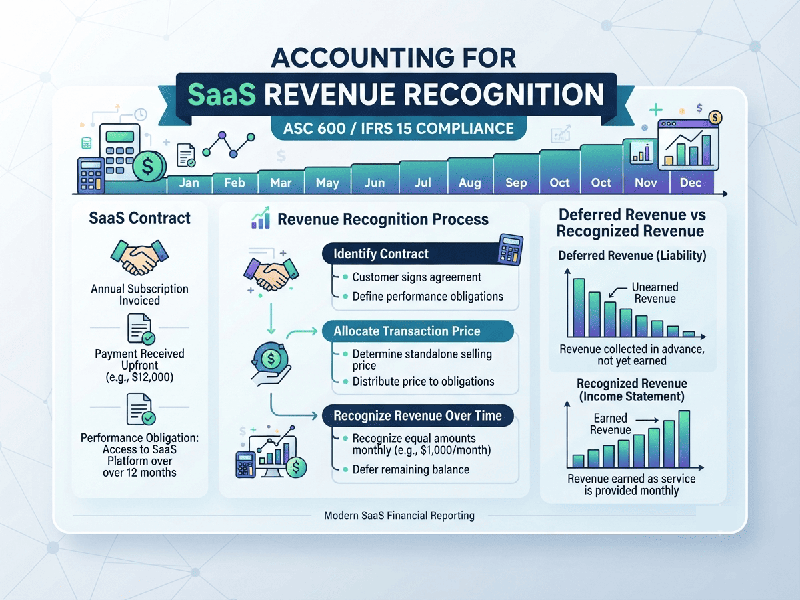
Accounting for SaaS Revenue Recognition
For Software-as-a-Service (SaaS) companies, revenue
recognition is governed by ASC 606 (US GAAP) and IFRS 15
(International Financial Reporting Standards). Under these standards, revenue
must be recognized when control of promised goods or services is transferred to
the customer, reflecting the exact value of what has been delivered—regardless
of when the customer is actually billed or pays.
Because SaaS customers typically pay upfront annual or
multi-year subscriptions for cloud access, a major disconnect exists between cash
flow (cash collected) and recognized revenue (earned over time).
The 5-Step Revenue Model Applied to SaaS
Under ASC 606/IFRS 15, SaaS providers must evaluate
every customer contract using a five-step framework:
1. Identify the Contract with the Customer
What it means: A contract exists when both parties have approved it,
payment terms are identifiable, commercial substance exists, and collectibility
is probable.
SaaS context: Standard terms of service (ToS), Master Subscription
Agreements (MSAs), and signed order forms combined constitute the contract.
2. Identify the Performance Obligations
What it means: Distinct promises within the contract to transfer goods or
services to the customer.
SaaS context: Common obligations include access to the cloud platform
(hosting), professional implementation services, customized software
development, and customer support/maintenance. If a service is
"distinct" (the customer can benefit from it on its own), it must be
accounted for as a separate performance obligation.
3. Determine the Transaction Price
What it means: The amount of consideration the company expects to be
entitled to in exchange for goods or services.
SaaS context: Includes fixed subscription fees, volume tiers, usage-based
fees, and any discounts, rebates, or variable considerations (e.g.,
service-level agreement penalties or usage overages).
4. Allocate the Transaction Price
What it means: Assigning the total transaction price to each distinct
performance obligation based on their relative Standalone Selling Price
(SSP).
SaaS context: If a contract includes both a 1-year software subscription
and custom integration work, the total contract value must be split between the
two based on what the company normally charges for each independently.
5. Recognize Revenue When (or as) Obligations are
Satisfied
What it means: Recognizing revenue either at a point in time or over
time as the customer receives and consumes the benefit.
SaaS context: Cloud subscription access is a "stand-ready"
obligation delivered continuously; therefore, it is recognized ratably over
time across the subscription term.
Accounting Treatment for Common SaaS Revenue Elements
Subscription Revenue: Recognized ratably on a
straight-line basis over the subscription period (e.g., $12,000 annual contract
billed upfront is recognized at $1,000 per month). Amounts billed in advance
are recorded on the balance sheet as Deferred Revenue (Contract Liabilities).
Setup & Implementation Fees:
If the setup service is not distinct (meaning
the customer cannot use the software without the setup, or it involves
significant customization), the fee is deferred and recognized ratably over the
subscription term.
If the setup service is distinct (e.g.,
standard data migration that another vendor could perform), the revenue is
recognized when the service is completed.
Professional & Consulting Services: Usually recognized over time as the
services are performed (often measured by input methods like labor hours
expended) or at a point in time upon milestone delivery.
Sales Commissions (Deferred Contract Costs): Under ASC 340-40, sales commissions
paid to acquire a contract are not expensed immediately. Instead, they are
capitalized as an asset and amortized on a systematic basis over the estimated
customer life (which often extends beyond the initial contract term if renewals
are expected).