Web Risk Mitigation via Pen Testing
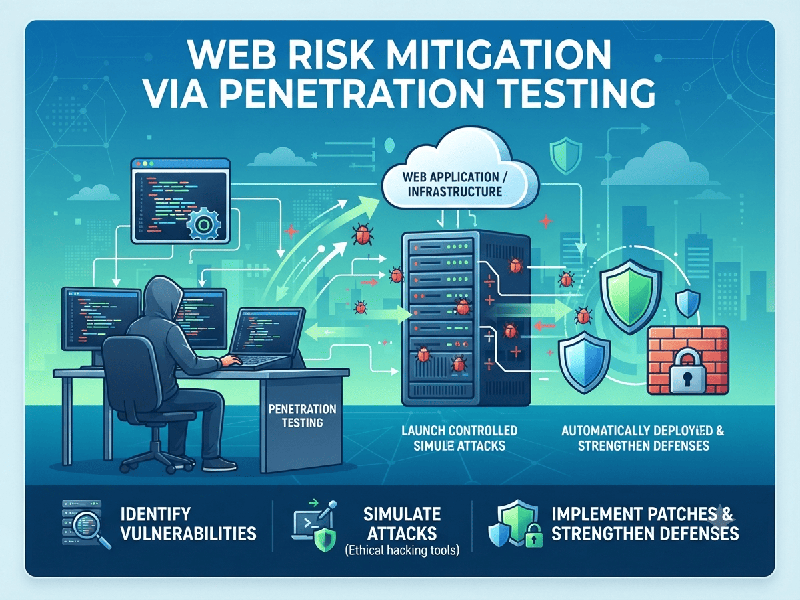
Web Risk Mitigation via Penetration Testing is a proactive cybersecurity
practice where ethical hackers simulate real-world cyberattacks against web
applications, APIs, and digital infrastructures to uncover vulnerabilities
before malicious actors can exploit them. Rather than waiting for a breach,
penetration testing (pen testing) provides a controlled stress-test of a
system's defenses, allowing security teams to remediate gaps and secure
sensitive data.
Core Stages of a Web Penetration Testing Framework
1.
Scoping & Reconnaissance
o Defining the boundaries, target web
applications, and objectives of the test. Gather intelligence on the target
system (e.g., exposed subdomains, technology stack, and third-party
integrations).
2.
Vulnerability Analysis & Threat Modeling
o Scanning the web application using
automated tools and manual inspection to identify potential entry points,
outdated libraries, and misconfigurations.
3.
Exploitation & Attack Simulation
o Actively attempting to bypass
security controls—such as SQL injection (SQLi), Cross-Site Scripting (XSS),
broken authentication, or insecure direct object references (IDOR)—to determine
the real-world impact.
4.
Post-Exploitation & Lateral Movement
o Assessing how deep an attacker could
penetrate into the system, database, or connected corporate network once
initial access is gained.
5.
Reporting & Remediation Guidance
o Delivering a comprehensive risk
report detailing vulnerabilities ranked by severity (Critical, High, Medium,
Low), complete with proof-of-concept steps and actionable recommendations for
patches.
Common Web Vulnerabilities Uncovered
- OWASP Top 10 Risks: Identifying critical flaws like
injection flaws, security misconfigurations, broken access controls, and
server-side request forgery (SSRF).
- API Insecurity: Finding broken object-level
authorization (BOLA) and excessive data exposure in modern application
endpoints.
- Authentication Flaws: Spotting weak password
policies, flawed multi-factor authentication (MFA) implementations, or
session management vulnerabilities.