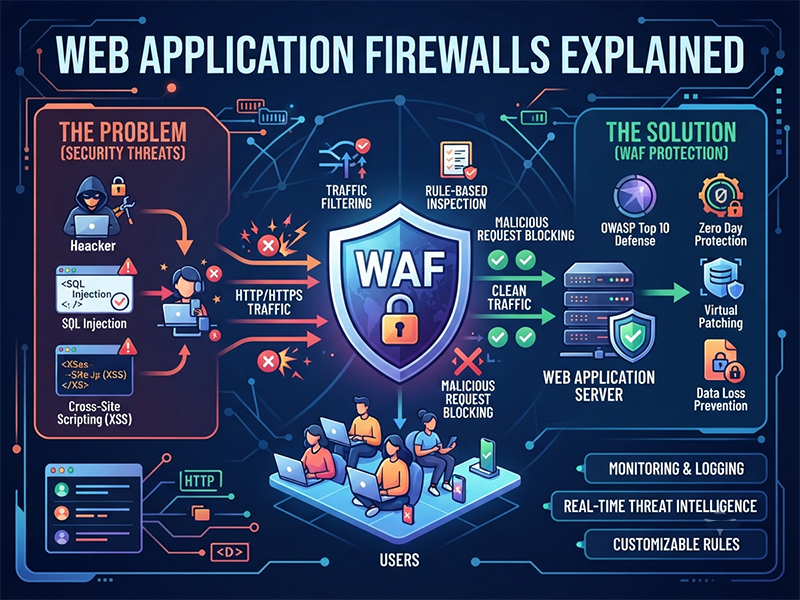
Web Application Firewalls Explained
A Web Application Firewall (WAF) is a
specialized security solution designed to protect web applications by
filtering, monitoring, and blocking HTTP/HTTPS traffic between a web
application and the internet. Unlike traditional network firewalls that protect
the perimeter of a network, a WAF operates at the application layer (Layer 7 of
the OSI model), inspecting the specific payloads of web traffic to stop
sophisticated attacks.
How a WAF Works
1.
Traffic Inspection: It intercepts incoming web requests before they reach the web server or
application backend.
2.
Rule Matching & Analysis: It evaluates traffic against a set of security policies,
signature databases, and behavioral baselines.
3.
Action Execution: Depending on the evaluation, the WAF either allows legitimate traffic
through, blocks malicious requests, or challenges suspicious requests (e.g.,
via CAPTCHA).
Key Threat Protections
- The OWASP Top 10: Protects against the most
critical web application vulnerabilities, including SQL Injection
(SQLi), Cross-Site Scripting (XSS), and remote code execution.
- Zero-Day Exploits: Utilizes behavioral analysis
and anomaly detection to identify and block novel attacks that lack
pre-existing signatures.
- Layer 7 DDoS Attacks: Mitigates application-layer
denial-of-service attempts, such as HTTP floods designed to exhaust server
resources.
- Bot Mitigation: Detects and blocks malicious
automated scrapers, credential-stuffing scripts, and automated
account-takeover attempts.
Deployment Models
- Cloud-Based WAF (SECaaS): Managed as a service (e.g.,
Cloudflare, AWS WAF, Akamai). It is easy to deploy, highly scalable, and
handles threats at the network edge before they reach your infrastructure.
- Network-Based (Hardware) WAF: Installed locally on-premises
as physical hardware. Offers low latency and maximum control but requires
significant upfront investment and maintenance.
- Host-Based (Software) WAF: Integrated directly into the
application server's operating system or codebase. Highly customizable but
can consume local server resources.