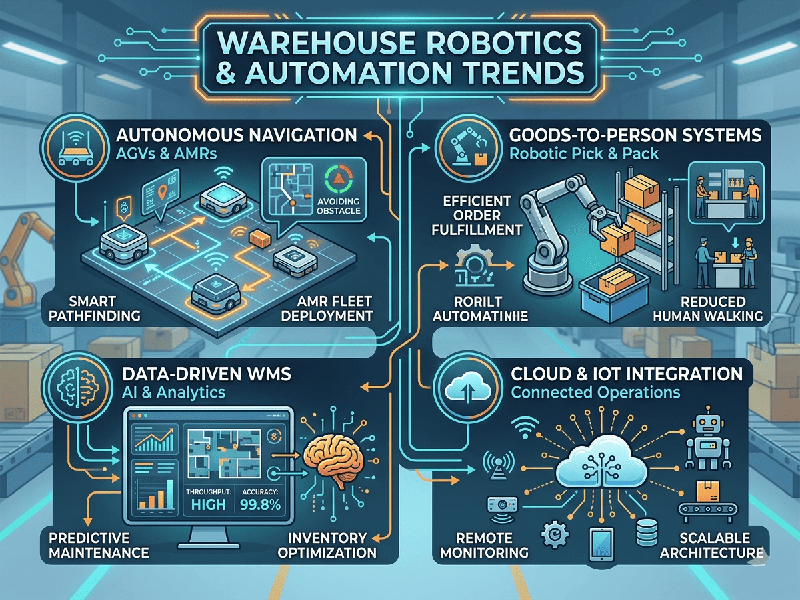
Warehouse Robotics & Automation Trends
The landscape of warehouse robotics and automation in 2026 is
defined by a shift from rigid, large-scale systems to flexible, AI-driven,
and modular ecosystems. The focus is no longer just on replacing manual
labor, but on enhancing human productivity, increasing operational resilience,
and managing complexity through intelligent software.
1. The Rise of AI as a "Co-Pilot"
Artificial Intelligence has evolved from a passive analytical
tool into an active operational co-pilot.
- AI-Driven Orchestration: Warehouse Management Systems
(WMS) and Warehouse Execution Systems (WES) now leverage machine learning
to prioritize tasks, dynamically allocate labor, and adjust workflows in
real-time based on order volume or external disruptions (e.g., weather,
traffic).
- Swarm Intelligence: Advanced algorithms manage
entire fleets of Autonomous Mobile Robots (AMRs), calculating optimal
paths to avoid congestion and bottlenecks, significantly boosting
throughput in high-density environments.
- Predictive Analytics: AI combines internal stock and
sales data with external factors to improve demand forecasting, inventory
slotting, and labor requirement predictions.
2. Flexible & Modular Robotics
The industry is moving away from "all-in"
monolithic automation toward modular, scalable solutions that can be deployed
in phases.
- Hybrid Systems: Warehouses are increasingly
integrating mobile robots with fixed automation (like AS/RS or conveyors).
Each technology is placed where it performs best, allowing for a phased
growth strategy that aligns with capital availability and demand
fluctuations.
- AMR Evolution: Autonomous Mobile Robots are
becoming more sophisticated, moving beyond simple material transport to
specialized tasks like automated item picking (using robotic arms) and
real-time inventory cycle counting via computer vision.
- Scalability: Many vendors now offer
"Robotics as a Service" (RaaS), lowering the barrier to entry
for smaller enterprises and allowing for rapid, low-risk scaling.
3. "Seeing" the Warehouse: Computer Vision
Computer vision is now fully embedded in daily processes,
providing "zero-touch" quality control.
- Automated Verification: Camera systems integrated with
deep learning identify barcodes, item numbers, and volumes automatically
as goods move through the facility.
- Intelligent Returns: AI-guided vision helps
categorize returns instantly (e.g., re-sell, process, or reject),
drastically accelerating reverse logistics.
- Error Detection: Real-time visual checks
identify damaged packaging or incorrect labeling at the goods-in stage,
preventing downstream operational issues.
4. Strategic Focus Areas for 2026
- Micro-Fulfillment Centers
(MFCs):
High-density, compact automated facilities located closer to urban centers
are becoming essential for meeting the growing demand for rapid
(same-day/next-day) delivery.
- Worker-Centric Design: Automation is increasingly
designed to work alongside humans. Collaborative robots (cobots)
take on physically demanding or repetitive tasks, reducing strain and
allowing employees to focus on value-added activities like quality
oversight and complex decision-making.
- ESG & Sustainability: AI-powered systems are being
used to optimize energy consumption (smart lighting, route efficiency) and
track Scope 3 emissions, making sustainability a measurable metric in
logistics operations.