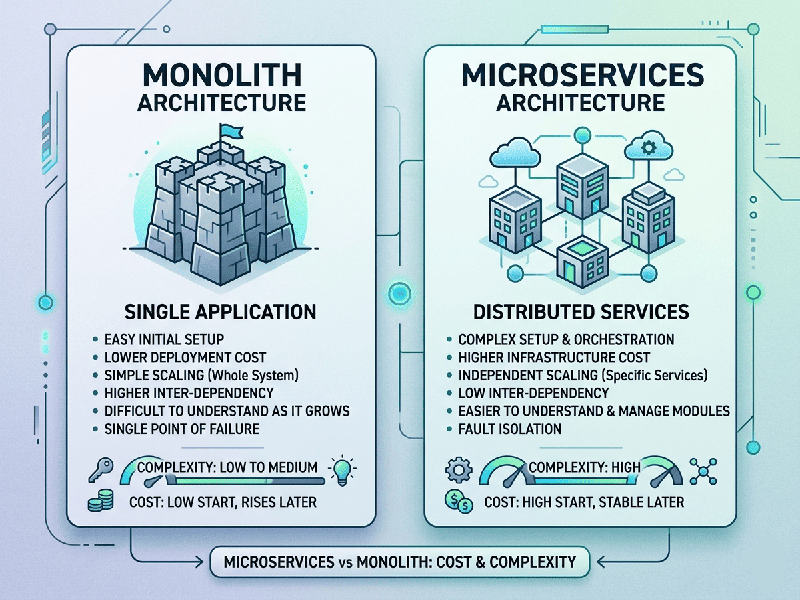
Microservices vs Monolith: Cost & Complexity
Choosing between a monolith and microservices is a
foundational architectural decision that impacts your operational budget,
developer productivity, and system reliability. For an SMB, the decision should
be driven by the stage of your product lifecycle rather than just
industry trends.
Monolithic Architecture: The Starting Point
In a monolith, all business logic, data access, and UI
components are bundled into a single codebase and deployed as one unit.
- Cost: Low initial overhead. You have
a single deployment pipeline, one database to manage, and lower
infrastructure complexity.
- Complexity: Low. Debugging is
straightforward (stack traces are local), and there is no need for complex
inter-service communication protocols.
- Best For: Startups, MVP development, and
small teams where speed to market is the primary driver.
Microservices Architecture: The Scaling Strategy
Microservices decompose an application into a collection of
loosely coupled, independently deployable services, each managing its own data
store and business domain.
- Cost: High. You face increased
infrastructure costs (many containers/servers), operational overhead
(observability, logging, CI/CD pipelines), and the need for specialized
DevOps talent.
- Complexity: High. You must handle
distributed system challenges like eventual consistency, service
discovery, latency between services, and complex API management.
- Best For: Large, high-traffic
applications, or organizations where independent, cross-functional teams
need to iterate quickly on different modules without affecting each other.