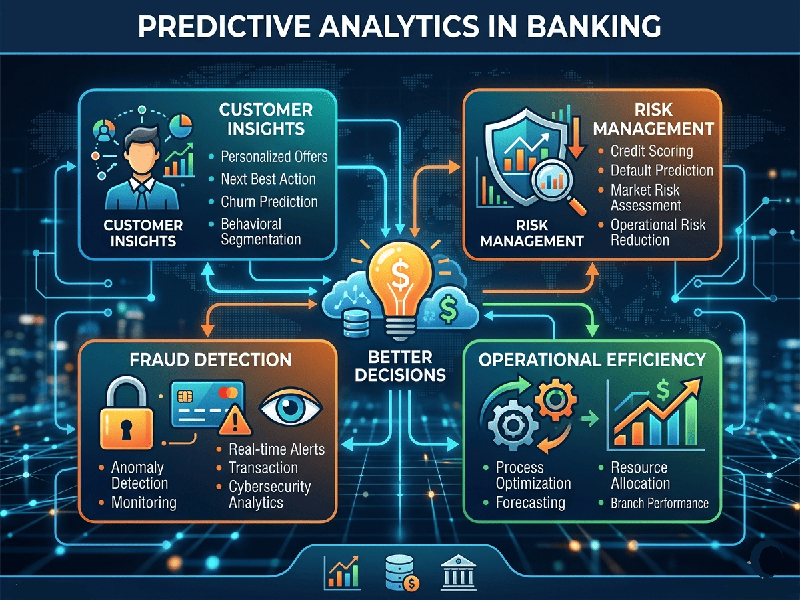
Predictive Analytics in Banking
Predictive analytics in banking utilizes historical data,
statistical algorithms, and machine learning techniques to identify the
likelihood of future outcomes. For a financial institution, it transforms raw
data—like transaction history, credit scores, and market trends—into actionable
intelligence.
Core Applications in Banking
- Credit Risk Assessment: Moving beyond static credit
scores, predictive models analyze real-time behaviors (e.g., spending
patterns, bill payment consistency) to assess a borrower’s default risk
more accurately.
- Fraud Detection: By establishing a
"baseline" for a customer's typical activity, machine learning
models can instantly flag anomalous transactions—such as a large purchase
in a foreign country—before the transaction is even finalized.
- Customer Lifetime Value (CLV)
& Churn:
Banks use predictive analytics to identify which customers are likely to
switch to a competitor (churn) based on drops in engagement, allowing for
proactive, personalized retention offers.
- Targeted Cross-Selling: By analyzing account balances
and life-stage events, banks can predict when a customer is likely to need
a specific product (e.g., a home loan, an education fund, or an insurance
policy) and present it at the exact right moment.
The Predictive Lifecycle
To implement these models effectively, institutions typically
follow this sequence:
1.
Data Collection: Gathering structured data (from core banking systems) and unstructured
data (social media sentiment, call logs).
2.
Data Cleaning:
Removing "noise" and handling missing values to ensure the model
isn't trained on inaccurate information.
3.
Model Building:
Applying algorithms (such as Regression, Decision Trees, or Neural Networks) to
identify patterns.
4.
Deployment & Monitoring: Integrating the model into production and tracking its
performance over time to prevent "model drift," where the algorithm
loses accuracy due to changing market conditions.