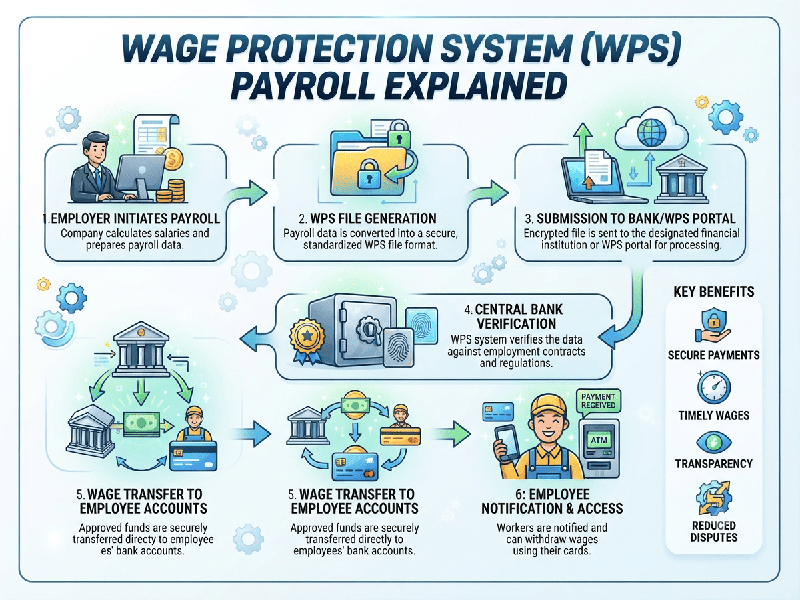
Wage Protection System (WPS) Payroll Explained
The Wage Protection System (WPS) is an
electronic salary transfer infrastructure mandated across Gulf Cooperation
Council (GCC) countries—pioneered by the UAE in 2009 and subsequently adopted
in Saudi Arabia (Mudad), Qatar, Oman, Bahrain, and Kuwait.
It requires private-sector employers to pay employee
wages strictly through Central Bank-approved banks, exchange houses, or
authorized fintech agents rather than in cash. By routing payroll files through
a government-monitored clearinghouse, labor ministries verify in real time that
workers are paid on time and in full accordance with their registered
employment contracts.
How WPS Payroll Works (Step-by-Step)
While file formats differ slightly by country, the
end-to-end WPS workflow follows a standardized five-step cycle:
Employer & Employee Onboarding: The employer registers its
establishment with the relevant labor authority (e.g., MOHRE in the UAE, MHRSD
in Saudi Arabia) and links a corporate bank account or approved WPS agent.
Every employee must have a valid work permit, a registered contract, and a
personal bank account (IBAN) or WPS payroll card.
Salary Information File (SIF) Generation: At the end of each pay cycle, HR or
payroll software generates a standardized electronic payroll file—known in the
UAE and Oman as a Salary Information File (SIF). This file contains:
Employer establishment ID and bank routing code
Employee labor card / personal ID number and IBAN
Pay period dates and number of working/leave days
Fixed salary, variable allowances/overtime, and any
lawful deductions
File Submission & Funding: The employer uploads the SIF file to
its bank or WPS agent's corporate portal and transfers the total gross payroll
amount into the clearing account.
Central Bank & Ministry Validation: The bank transmits the payment
records to the Central Bank and Labor Ministry. The system cross-checks the
submitted amounts against registered employment contracts. If an employee ID is
invalid or a deduction exceeds legal limits, the file or specific line item is
flagged or rejected.
Salary Disbursement: Once cleared, funds are credited directly into
employees' bank accounts or payroll cards, and the employer receives a WPS
settlement receipt for compliance records.
Key Rules & Compliance Benchmarks (UAE & GCC)
In the UAE—the most prominent WPS jurisdiction—Ministerial
Resolution No. 340 of 2026 (effective June 1, 2026) tightened compliance
deadlines and eliminated informal grace windows:
Strict Due Date: Salaries for the preceding month are due on the 1st
day of each Gregorian month, with no automatic weekend or holiday
extensions. Payroll files must be submitted 2–3 business days prior to ensure
settlement by the 1st.
The 85% Compliance Threshold: To avoid automatic non-compliance
flags, an establishment must transfer at least 85% of its total monthly wage
bill on time. At the individual level, an employee is considered paid if
they receive at least 85% of their contractual salary, provided any remaining
shortfall is backed by documented, lawful deductions (such as approved loan
installments or unpaid leave).
Zero Cash Payments: Paying salaries in cash or via personal bank
transfers outside the WPS channel does not count toward compliance and is
treated as non-payment.