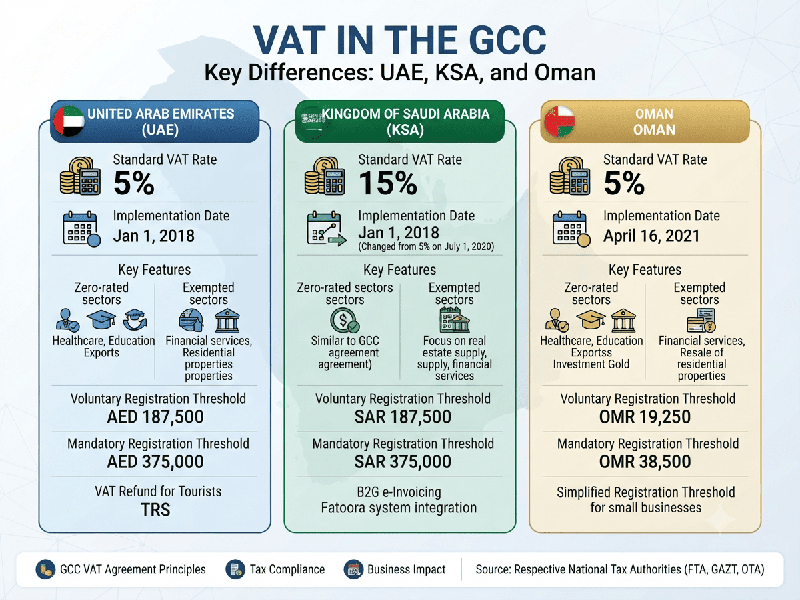
VAT in the GCC: Key Differences Between UAE, KSA and Oman
1. Standard VAT Rates & Pricing Impact
Saudi Arabia (15%): At triple the rate of its neighbors, KSA imposes a
much heavier working capital and pricing impact. Businesses operating in KSA
face significantly higher cash-flow exposure on unpaid customer invoices and
import VAT.
UAE & Oman (5%): Both countries maintain the baseline 5% rate, keeping
consumer price impacts low and simplifying cross-border margin structures
between the two markets.
2. Zero-Rated vs. Exempt Supplies
While all three jurisdictions zero-rate exports
outside the GCC and international transportation, domestic treatment of
essential sectors diverges:
Basic Foodstuffs:
Oman applies a 0% (zero-rate) on over 500 basic food items
(such as meat, fish, dairy, grains, fruits, and vegetables).
UAE and KSA tax almost all food and beverage items at their standard
rates (5% and 15%, respectively).
Healthcare & Education:
UAE & Oman generally zero-rate qualifying preventive/basic
healthcare services and approved educational services (allowing providers to
recover input VAT).
KSA treats private healthcare and private education for
non-citizens as standard-rated (15%), while services provided to Saudi
citizens are effectively state-borne/zero-rated under specific mechanisms.
Real Estate:
UAE: First supply of new residential buildings within 3 years is zero-rated;
subsequent residential sales and leases are exempt; commercial real
estate is 5%.
KSA: Residential and commercial real estate sales/transfers are exempt
from VAT (and instead subject to a separate 5% Real Estate Transaction Tax,
or RETT), while commercial rentals are taxed at 15% and residential
rentals are exempt.
Oman: Residential property rentals and resales are exempt,
whereas commercial real estate sales and leases are taxed at 5%.
3. Free Zones & Designated Zones
UAE: Recognizes specific Designated Zones (fenced free
zones with strict customs controls) that are treated as "outside the
UAE" for VAT purposes on qualifying goods movements, allowing tax-free
trading within and between Designated Zones.
KSA: Operates Special Integrated Logistics Zones (SILZ)
and Special Economic Zones (SEZs) where goods under customs suspension enjoy
zero-rating or VAT suspension under strict conditions, though general free
zones are far less prevalent than in the UAE.
Oman: Treats Special Economic Zones (such as Duqm) and Free Zones
(Salalah, Sohar, Al Mazunah) under 0% VAT rules for qualifying supplies
of goods and services made to/within the zones, provided specific registration
and operational conditions are met.
4. Input VAT Recovery & Time Limits
UAE: Tightened rules require businesses to claim input VAT within
specific statutory windows, with a strict 5-year limitation period for
recovering unclaimed historical input tax credits. Blocked input tax includes
entertainment expenses, employee-use motor vehicles, and employee medical
insurance beyond statutory minimums.
KSA: Allows input tax recovery up to 5 years following the
calendar year of the supply, provided the taxpayer holds a ZATCA-compliant
e-invoice.
Oman: Requires input VAT to be claimed within 3 years from
the end of the tax period in which the right to deduct arose—a noticeably
shorter window than in the UAE or KSA.
5. E-Invoicing Architectures
KSA (Clearance & Reporting Model): Already operational under ZATCA; B2B
invoices require real-time API clearance before issuance, and B2C invoices must
be reported within 24 hours.
UAE (Decentralized 5-Corner Model): Uses Peppol PINT-AE via Accredited
Service Providers (ASPs) without pre-clearance, rolling out in 2027 exclusively
for B2B and B2G transactions.
Oman (Fawtara / PINT-OM): Launching mandatory phases in April
and October 2027 for all VAT-registered businesses (covering both B2B and B2C),
combining real-time B2B exchange with a 24-hour window for B2C invoices.