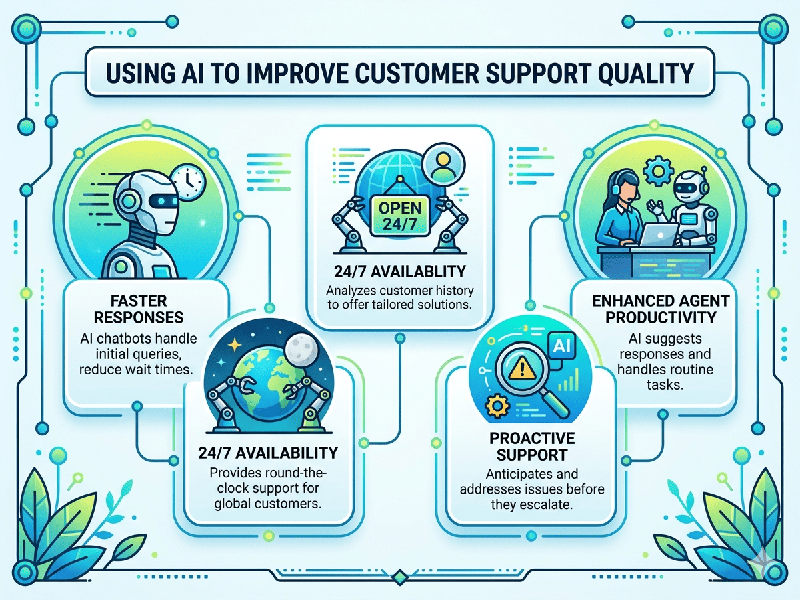
Using AI to Improve Customer Support Quality
Customer support has fundamentally shifted from a model of
"deflection" (trying to keep customers away from human agents) to a
model of high-fidelity resolution and contextual intelligence. Early
chatbot implementations often frustrated users by acting as digital dead-ends,
but modern artificial intelligence focuses heavily on enhancing the actual
quality, accuracy, and emotional resonance of support.
Using AI to improve customer support quality relies on a
careful balance between autonomous problem-solving and smart agent empowerment.
1. Transforming the Frontline: Autonomous AI Agents
Unlike legacy chatbots that could only match keywords to
pre-written FAQ links, modern Agentic AI understands intent, reasoning,
and multi-step execution.
- Memory-Rich Personalization: Modern AI platforms maintain
context across multiple channels (chat, email, voice) and previous
interactions. A customer never has to repeat their issue or account
history; the AI securely references past touchpoints to deliver tailored
support.
- Multimodal Troubleshooting: Customers are no longer limited
to text. They can upload an image or video of a faulty part or an error
screen directly into the support thread. AI analyzes the visual data
alongside the text to instantly diagnose the issue.
- Autonomous Resolution: For routine but multi-step tasks (such as processing an e-commerce refund, modifying an order, or verifying basic tracking data), AI agents securely interact with internal back-office CRMs and ERP systems to completely resolve the ticket without human intervention.
2. Elevating Humans: "Agent Assist" and
Augmentation
AI’s biggest quality impact often happens behind the scenes
by removing the administrative drag that leads to human agent burnout and
errors.
Real-Time Policy
and Knowledge Retrieval: When a complex query escalates to a human agent,
an AI co-pilot listens or reads along in real time. It automatically surfaces
the exact internal documentation, compliance guidelines, or troubleshooting
steps required, saving the agent from hunting through messy internal wikis.
Contextual
Interaction Summaries: Before a human agent takes over an escalated ticket,
AI generates a concise bulleted summary of everything the customer has already
tried or communicated. This drastically lowers customer effort and frustration.
Emotion-Aware
Routing: Advanced sentiment analysis can read text cues or tone-of-voice
frequencies to gauge irritation, distress, or urgency. If a customer is highly
frustrated, the AI detects it immediately and routes the conversation to a
specialized senior agent equipped with the proper context.