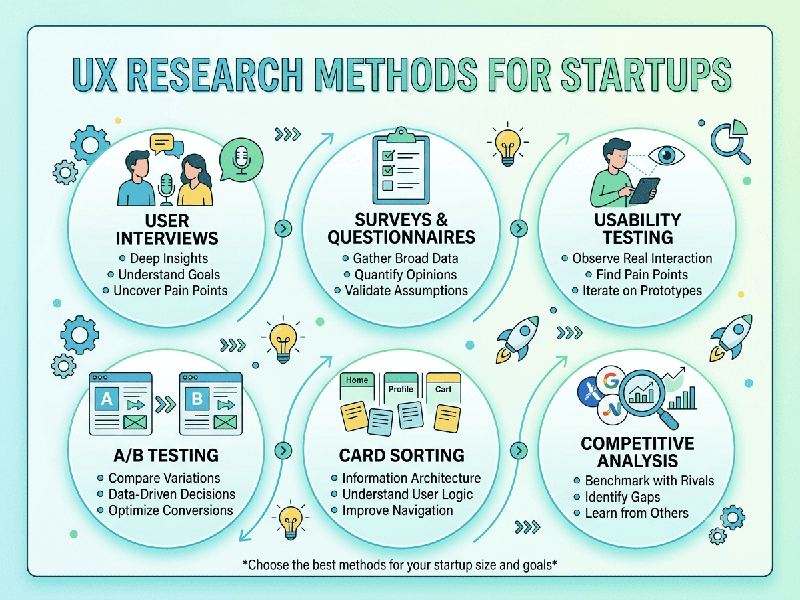
UX Research Methods for Startups
For startups operating with limited time and budget,
the most effective UX research approach is Lean UX. This framework
replaces long, formal research phases with a "Think-Make-Check" loop
that prioritizes fast, actionable learning.
1. The Lean UX Framework (Think-Make-Check)
- Think: The team collaboratively
defines the business problem and makes explicit assumptions about users
and solutions.
- Make: You build the smallest possible
artifact—a sketch, a paper prototype, or a low-fidelity digital
wireframe—to test the hypothesis.
- Check: You test that artifact with
real users. Based on the results, you iterate, pivot, or proceed.
2. High-Impact, Low-Cost Methods
When resources are constrained, focus on these methods
to get the highest "insight-to-cost" ratio:
- Guerrilla Testing: Take your prototype to a local
café, co-working space, or public area. Ask random people (your target
demographic) to perform a 5–10 minute task. It’s free, fast, and excellent
for identifying major usability blockers.
- Remote Unmoderated Testing: Use platforms like Maze
or Lyssna to send tasks to users. They record their screens and
"think aloud" while completing tasks. This is significantly
cheaper than hiring a moderator and provides quantitative data (task
success rates) alongside qualitative feedback.
- Behavioral Observation
(Heatmaps):
Tools like Hotjar allow you to see where users click, scroll, and
drop off on your site. This is "passive research" that reveals
where your site is failing before you even conduct a formal interview.
- User Interviews (The 5-User
Rule): You
don't need dozens of participants to find most usability issues. Studies
consistently show that 5 users are sufficient to uncover
approximately 85% of major usability problems. Focus on open-ended
questions about their pain points and workflows.
- Social Media Listening: Monitor Reddit, industry
forums, or competitor comments. This provides unfiltered,
"in-the-wild" feedback on what users truly value or hate about
existing solutions.
3. Implementation Tips for 2026
- Document Assumptions: Before building, write down
your core assumptions (e.g., "Users will pay for X because of
Y"). Validating these is your primary goal.
- Connect to Business Metrics: Even early-stage research
should be linked to outcomes. For example, if you are working on Agrived
Foods, your research should aim to validate if a new digital feature
improves "customer trust" or "checkout conversion
rates" (measured in ₹).
- Involve the Whole Team: When developers and product
managers observe research sessions, they build empathy for the user faster
than any report or slide deck could provide.