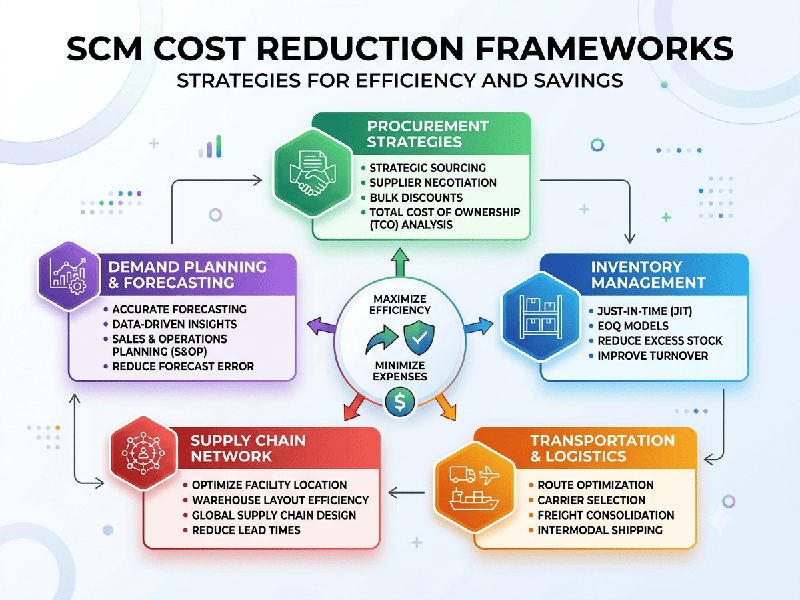
SCM Cost Reduction Frameworks
To effectively manage supply chain costs for a
business like Agrived Foods in 2026, you must shift from a
"cost-cutting" mindset to a "Total Value" framework. Given
the complexities of the Indian organic export sector—such as seasonal
variability, certification overheads, and trade policy shifts—a holistic approach
is essential.
1. The "Total Value" Strategic Framework
Instead of focusing solely on the lowest price,
evaluate the Total Cost-to-Serve (TCS). This framework accounts for the
entire lifecycle of a product from the farm to the international customer.
- End-to-End Visibility: Utilize digital "control
towers" to monitor shipments in real-time. This prevents costly
delays at ports and helps avoid spoilage, which is critical for organic
perishables.
- Sourcing Agility: Move beyond single-source
dependencies. By dual-sourcing or regionalizing your supply network, you
protect yourself against the "price volatility" that often
plagues the organic sector.
- Predictive Demand Sensing: Use AI-driven analytics to move
from monthly batch forecasting to continuous demand signals. This
minimizes inventory carrying costs and prevents the expensive cycle of
stockouts and over-correction.
2. Operational Cost-Reduction Strategies
- Group Certification Models: For organic exports,
certification is a significant overhead. Participating in or facilitating
"Internal Control Systems" (ICS) for farmers significantly
reduces individual certification costs and ensures consistent quality
management.
- Automated Procurement: Streamline repetitive tasks
like invoice matching, supplier performance tracking, and replenishment
triggers. Freeing your team from manual documentation allows them to focus
on high-value supplier relationships.
- Regionalized Warehousing: With the "e-commerce
boom" in India, consider a hybrid logistics model—centralizing
primary logistics for exports while utilizing decentralized,
micro-fulfillment centers for domestic reach to reduce last-mile delivery
costs.
3. Technological Levers for 2026
- Digital Twins: Use virtual replicas of your
supply network to simulate "what-if" scenarios (e.g., changes in
export tariffs or sudden port disruptions). This allows you to test the
impact of a decision on your ₹ (Rupee) margins before committing
capital.
- Blockchain for Traceability: As global markets demand
stricter organic certification proofs, blockchain provides an immutable
record of product origin. This reduces the time and cost associated with
manual audits and compliance checks.
- Smart Cold Chain: Since you deal with organic
food, invest in IoT-enabled cold chain monitoring to track temperature and
humidity. Preventing even one spoiled shipment pays for the technology
itself.
4. Navigating the Indian Export Context
- Trade Policy Hedge: Stay updated on APEDA and FSSAI
regulations. Leverage government initiatives like MOVCDNER or PKVY
for support in scaling organic infrastructure, which can offset your
initial setup and operational costs.
- Tariff Absorption Strategy: With global trade volatility,
prepare for the "tariff absorption wall." If duties increase,
model whether to absorb those costs or pass them to the consumer well in
advance to maintain stable margins.