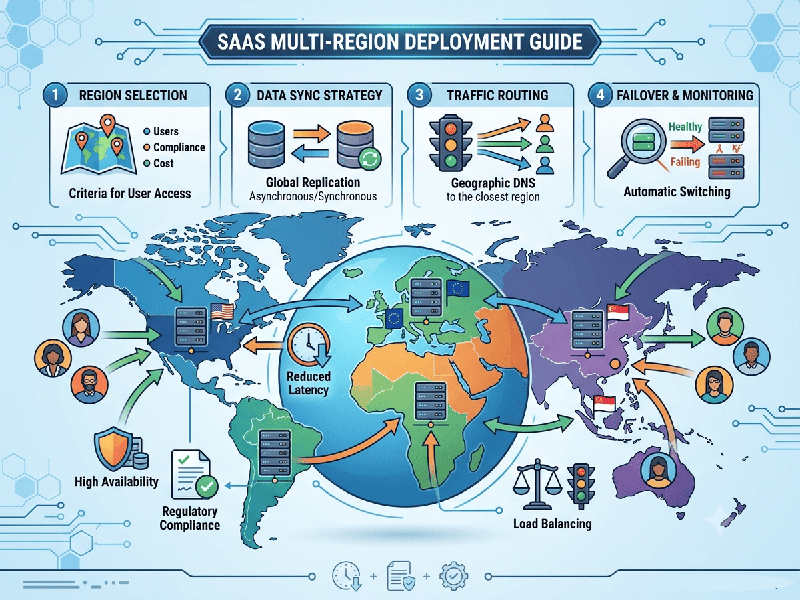
SaaS Multi-Region Deployment Guide
Deploying a SaaS application across multiple regions
is essential for reducing latency, ensuring high availability, and meeting data
residency requirements. This guide outlines the architectural patterns and key
considerations for a robust multi-region deployment.
1. Core Architectural Strategies
There are two primary ways to approach multi-region
deployments:
- Active-Active: Traffic is served from multiple
regions simultaneously. This provides the highest availability and lowest
latency but adds significant complexity to data synchronization.
- Active-Passive (Failover): One region handles primary
traffic while another serves as a "hot" or "warm"
standby. This is simpler to manage but leads to higher latency for users
routed to the standby region if the primary fails.
2. Key Components of the Stack
Global Traffic Management
To route users to the nearest healthy region, you need
a Global Server Load Balancer (GSLB).
- Tools: AWS Route 53 (Latency-based
routing), Cloudflare Load Balancing, or Google Cloud Load Balancing.
- Mechanism: Uses DNS or Anycast IP to
direct requests to the closest regional endpoint.
Data Layer Synchronization
This is the most challenging aspect of multi-region
deployment.
- Global Databases: Utilize managed services that
handle replication automatically.
o Examples: AWS Aurora Global Database, Google
Cloud Spanner, or Cosmos DB.
- Consistency Trade-offs: You must choose between Strong
Consistency (slower, synchronous replication) and Eventual
Consistency (faster, asynchronous replication).
3. Best Practices
1.
Automate Everything: With multiple regions, manual configuration is a recipe for drift and
failure. Use CI/CD pipelines (GitHub Actions, GitLab CI) to deploy to all
regions simultaneously.
2.
Health Checks & Failover: Implement aggressive health checks. Your GSLB should
automatically stop routing traffic to a region if the application heartbeat
fails.
3.
Handle "Split-Brain" Scenarios: Ensure your database has a clear
"source of truth" election process to prevent data corruption during
network partitions.
4.
Gradual Rollouts: Always deploy changes to a "canary" region first to verify
stability before rolling out to the rest of your global infrastructure.
4. Visualizing Data Flow
The diagram above illustrates how a Global Load
Balancer intercepts user requests and intelligently routes them to the nearest
healthy regional cluster, while an underlying global database manages
replication between those regional compute nodes.