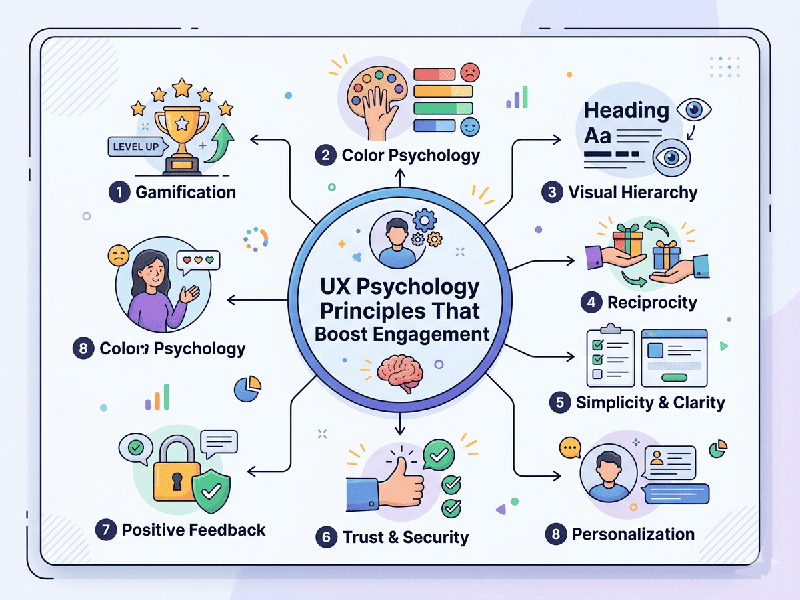
UX Psychology Principles That Boost Engagement
UX psychology is the bridge between how a user perceives an
interface and how they act upon it. By designing with human cognitive biases in
mind, you can create digital experiences that feel intuitive, reduce friction,
and keep users coming back.
1. The Von Restorff Effect (The Isolation Effect)
When multiple similar objects are present, the one that
differs from the rest is most likely to be remembered.
- Application: This is the foundation of Call-to-Action
(CTA) buttons. By using a distinct color, size, or shape for the
"Sign Up" button compared to the rest of the page, you guide the
user’s eye and increase the likelihood of a click.
- Engagement Boost: Directs users toward the
"High-Value" actions you want them to take.
2. Hick’s Law (Decision Paralysis)
The time it takes to make a decision increases with the
number and complexity of choices.
- Application: Simplification is key. Break
down complex processes (like checkout or onboarding) into small,
manageable steps rather than one long form.
- Engagement Boost: Reduces "drop-off"
rates by lowering the cognitive load required to complete a task.
3. Zeigarnik Effect (The Power of Unfinished Tasks)
People remember uncompleted or interrupted tasks better than
completed ones.
- Application: Use Progress Bars and
"profile completeness" meters. Seeing an 80% complete bar
creates a psychological tension that the user wants to resolve by reaching
100%.
- Engagement Boost: Encourages users to return to
the app to finish what they started.
4. Fitts's Law
The time to acquire a target is a function of the distance to
and size of the target.
- Application: Critical elements (like
navigation bars or "Buy Now" buttons) should be large and placed
in areas where the user’s thumb or cursor naturally rests. Conversely,
"Delete" or "Cancel" buttons are often placed in
harder-to-reach corners to prevent accidental errors.
- Engagement Boost: Makes the app feel
"fast" and physically effortless to use.
5. Goal Gradient Effect
The tendency to approach a goal with more effort as the goal
draws closer.
- Application: Give users a "head
start." For example, a loyalty card with two stamps already filled
out (even if the total required is higher) is more effective than an empty
card with fewer total slots.
- Engagement Boost: Increases retention by making
the user feel like they are already on a winning streak.