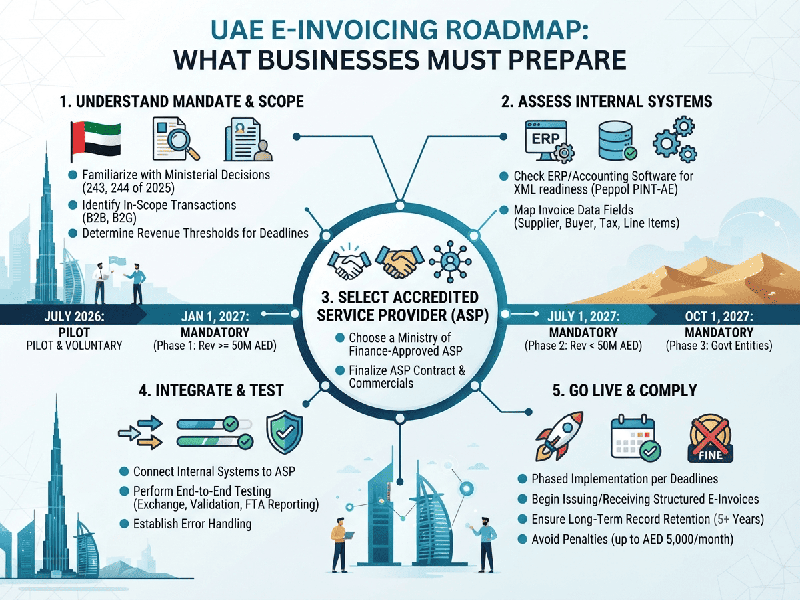
UAE E-Invoicing Roadmap: What Businesses Must Prepare
Unlike clearance models (such as Saudi Arabia’s ZATCA
Phase 2) where invoices must be approved by the tax authority before reaching
the buyer, the UAE uses a Decentralized Continuous Transaction Control and
Exchange (DCTCE) framework based on the Peppol 5-corner model:
Corner 1 (Supplier): Generates invoice data in their ERP or accounting
system.
Corner 2 (Supplier's ASP): Validates the data, converts it into
the UAE’s Peppol PINT-AE XML format, transmits it to the buyer's ASP,
and simultaneously reports the tax data to the FTA.
Corner 3 (Buyer's ASP): Receives and validates the XML
invoice, delivers it to the buyer, and reports the validated transaction data
to the FTA.
Corner 4 (Buyer): Ingests the structured invoice directly into their
accounts payable system.
Corner 5 (FTA): Receives tax data from both ASPs and cross-checks
submissions for audit and VAT compliance.
What Businesses Must Prepare
To avoid administrative penalties—which include AED
5,000 per month for failing to appoint an Accredited Service Provider (ASP)
or implement the system on time under Cabinet Decision No. 106 of 2025—finance
and IT teams must execute the following steps:
1. Appoint a MoF-Accredited Service Provider (ASP)
Businesses cannot connect directly to the FTA or the
Peppol network on their own; they must contract an approved ASP. Remember that
compliance is two-sided: you need an ASP both to issue sales
invoices and to receive supplier invoices. Verify that your chosen ASP
supports native API/ERP connectors for your accounting software and handles
both outbound and inbound Peppol routing.
2. Cleanse Master Data (TRN & TIN Verification)
Because both supplier and buyer ASPs report data
independently to the FTA, field mismatches will trigger validation failures and
tax discrepancies.
Audit customer and vendor master records for legal
names, registered addresses, and 15-digit Tax Registration Numbers (TRNs).
For non-VAT-registered counterparties, capture
their 10-digit Tax Identification Number (TIN), as B2B transactions
remain in scope even without VAT registration.
3. Upgrade ERP & Billing Systems to Support
PINT-AE XML
Standard PDFs emailed to clients will no longer
constitute valid tax invoices. Your ERP or invoicing software must be
configured to capture all mandatory PINT-AE data fields (such as
line-item tax codes, currency codes, payment terms, and electronic
addresses/Peppol IDs) and pass them cleanly to your ASP for XML conversion.
4. Reconfigure Accounts Payable & Credit Note
Workflows
Inbound Automation: Prepare your accounts payable team to receive
purchase invoices electronically via your ASP rather than scanning PDF
attachments.
Adjustments & Returns: Update workflows for Electronic
Credit Notes and debit notes, which must also be issued and transmitted in
PINT-AE XML format and linked to the original e-invoice reference.
5. Complete EmaraTax Onboarding & End-to-End
Testing
Register your e-invoicing endpoints on the FTA’s EmaraTax
portal alongside your ASP. Run sandbox simulations covering standard B2B sales,
reverse-charge transactions, zero-rated exports, and credit notes well ahead of
your mandatory go-live date to resolve schema errors before penalties take
effect.
6. Establish Compliant Digital Archiving
Ensure your ERP or ASP archives all transmitted and
received PINT-AE XML files—along with transmission logs—in an immutable,
retrievable format in accordance with UAE Tax Procedures Law retention periods.