UAE Corporate Tax: What SMEs Should Know
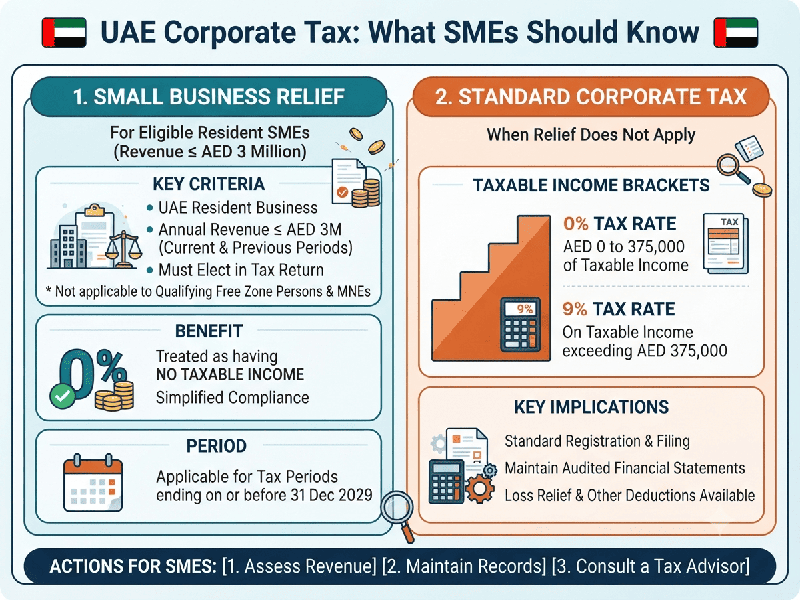
To reduce the compliance burden on micro and small
enterprises, the Ministry of Finance provides Small Business Relief (SBR)—formally
extended under Ministerial Decision No. 131 of 2026 for tax periods
ending on or before December 31, 2029.
How it works: Eligible businesses are treated as having no taxable
income for the tax period, meaning they pay 0% Corporate Tax
regardless of their profit margin and do not need to calculate complex tax
adjustments or carry forward tax losses.
Eligibility Rules:
Must be a UAE Resident Person (company or
eligible natural person).
Gross revenue must be AED 3 million or less in
the relevant tax period and in all previous tax periods. (Once revenue
crosses AED 3 million in any period, the business permanently loses eligibility
for future years).
Exclusions: Qualifying Free Zone Persons and members of large
Multinational Enterprise (MNE) groups (consolidated global revenue > AED
3.15 billion) cannot claim SBR.
Must Be Elected: SBR is not automatic. You must still register
for Corporate Tax and explicitly check the SBR election box when filing your
annual return on EmaraTax.
Mandatory Compliance Rules for SMEs
Even if your SME owes zero tax—whether due to profits
under AED 375,000 or Small Business Relief—you are legally bound by the
following rules:
1. Mandatory Registration
Companies (Mainland & Free Zone): All UAE juridical persons must
register via the EmaraTax portal, even if dormant or generating zero
revenue. Newly incorporated companies must register within 3 months of
incorporation.
Freelancers / Sole Establishments: Must register by March 31 of
the calendar year following the year their business turnover first exceeds AED
1 million.
2. Annual Return Filing & Payment (9-Month Window)
Businesses file only one Corporate Tax return per
financial year (unlike quarterly VAT returns).
Both the return filing and any tax payment are due
within 9 months from the end of the relevant financial year (e.g., for a
financial year ending December 31, 2026, the filing and payment deadline is September
30, 2027).
3. Deductible vs. Non-Deductible Expenses
To calculate taxable profit accurately, SMEs must
separate legitimate business expenses from disallowed items:
Entertainment Expenses: Only 50% of client/supplier
entertainment expenses (meals, events, hospitality) are tax-deductible.
Owner Salaries & Drawings: Reasonable salaries paid to
owner-managers are deductible, provided they reflect fair market value (arm's
length principle). Dividends and personal drawings are not deductible.
Fines & Penalties: Regulatory fines (such as traffic
tickets, VAT penalties, or municipality fines) are not deductible.
Interest Capping: Net interest expenditure is generally deductible up
to 30% of EBITDA (though an automatic safe-harbor threshold allows full
deduction if net interest does not exceed AED 12 million).
4. Related-Party Transactions & Transfer Pricing
If your SME transacts with sister companies,
shareholders, or connected persons (such as paying salaries or management fees
to owners/family members), transactions must be priced at market value
(Arm's Length Principle). Businesses exceeding specific thresholds (revenue
≥ AED 200 million or MNE group status) must maintain formal Master and Local
Files, while smaller SMEs must still disclose material related-party
transactions in their return.
5. Record-Keeping & Audit Requirements
7-Year Retention: All accounting records, invoices, bank statements,
and contracts supporting your tax return must be retained for 7 years
following the end of the relevant tax period.
Audited Financial Statements: Mandatory for Qualifying Free
Zone Persons (regardless of revenue) and for any taxable person whose
annual revenue exceeds AED 50 million. Standard mainland SMEs below AED
50 million do not need a statutory audit for Corporate Tax purposes, though
maintaining IFRS-compliant books is required.