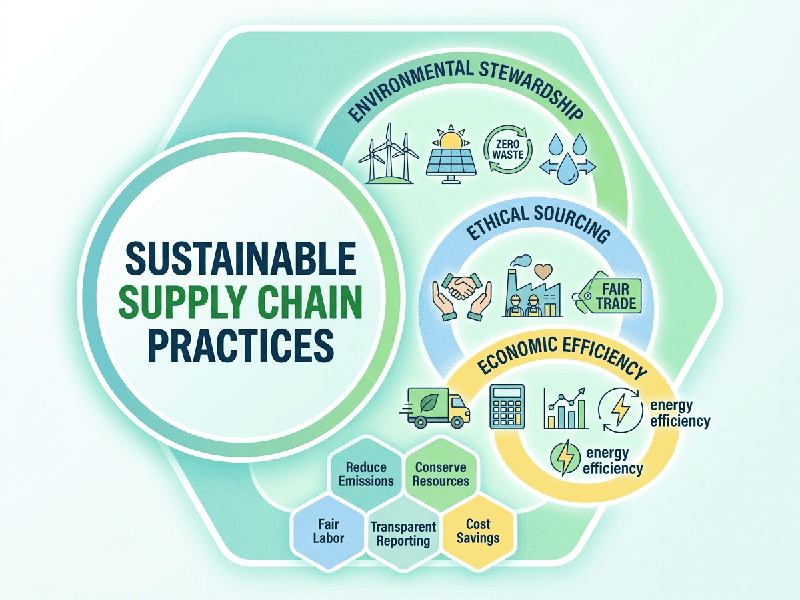
Sustainable Supply Chain Practices
Sustainable supply chain management has evolved from a
voluntary "nice-to-have" into a strategic necessity driven by
stringent global regulations, resource scarcity, and heightened consumer demand
for transparency.
The industry is currently shifting from a linear
"take-make-dispose" model toward a circular economy, where
sustainability is leveraged to control costs and mitigate volatility.
1. Core Pillars of Sustainable Supply Chains in 2026
- Circularity: Moving beyond recycling to
prioritize product design for disassembly, repair, and reuse. This reduces
dependency on virgin materials and protects against commodity price
spikes.
- End-to-End Visibility: Utilizing digital twins, IoT,
and AI to track material flows from raw extraction to final disposal. This
level of traceability is now a regulatory mandate in many regions (e.g.,
EU due diligence directives).
- Scope 3 Emission Management: Moving from internal emissions
tracking to full value-chain carbon mapping. Companies are increasingly
integrating carbon data directly into procurement decisions.
- Social & Ethical Governance: Prioritizing human rights and
labor standards. Beyond mere compliance, this involves active supplier
engagement and capacity building to ensure the entire network meets
ethical benchmarks.
2. Best Practices for Implementation
Strategic Procurement
- Supplier Risk Mapping: Use environmental and social
criteria to pre-qualify and select partners.
- Standardization: Adopt frameworks like ISO
20400 for sustainable procurement to ensure consistency across global
operations.
- Long-Term Partnerships: Shift from transactional,
short-term contracts to collaborative relationships that incentivize
suppliers to invest in greener technologies.
Operational Excellence
- Green Logistics: Implement route optimization to
minimize fuel consumption and transition to electric or hybrid delivery
fleets.
- Data-Driven Decision Making: Use AI-embedded platforms to
simulate the "total value" impact—balancing cost, service, risk,
and sustainability—before executing a supply chain decision.
- Waste Minimization: Redesign packaging to be fully
circular and optimize inventory levels to prevent overstocking and
subsequent waste.
3. The Role of Technology (The "Human + Machine"
Shift)
In 2026, technology is the primary enabler of sustainability,
with three specific trends:
1.
AI Agents as Team Members: AI no longer just provides dashboards; "agentic"
AI identifies sustainability risks, proposes alternative low-carbon routes, and
automatically triggers corrective actions within defined guardrails.
2.
Connected Intelligence: Enterprise-wide AI links the supply chain with Finance, ESG,
and HR systems to form an autonomous ecosystem, ensuring sustainability goals
are not siloed.
3.
Digital Twins:
Used to stress-test supply chains against climate disruptions or regulatory
changes, allowing companies to evaluate trade-offs before physical changes are
made.