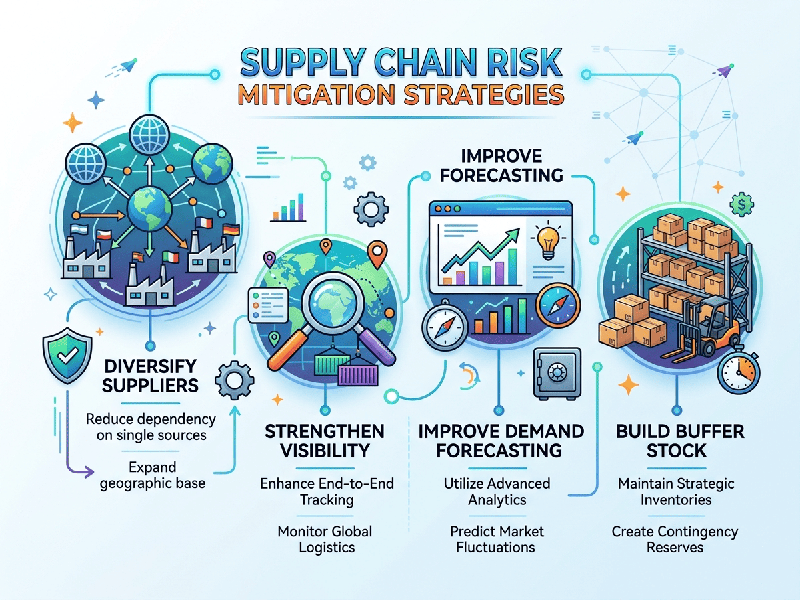
Supply Chain Risk Mitigation Strategies
Supply chain resilience has moved from a "just-in-case" philosophy to a data-driven, operational necessity. Mitigation is no longer just about having a backup plan; it is about building a system that can absorb shocks without collapsing.
1. Multi-Sourcing and "Friend-Shoring"
Relying on a single supplier or a single geographic region is
now considered a high-risk failure point.
- Diversification: Transition from
"Single-Source" to "Multi-Source" for critical
components. If one region faces a climate event or geopolitical shift,
production remains viable elsewhere.
- Regional Hubs: Use "Near-shoring"
(moving production closer to the end consumer) or
"Friend-shoring" (sourcing from countries with stable trade
agreements) to reduce transit times and customs volatility.
2. End-to-End Visibility (The "Digital Twin")
You cannot mitigate what you cannot see. Many risks hide in
"Tier 2" or "Tier 3" suppliers (the suppliers of your
suppliers).
- Supply Chain Mapping: Use AI-driven platforms to map
your entire supply network. This allows you to identify if multiple Tier 1
vendors are actually sourcing from the same high-risk Tier 2 factory.
- Real-Time Tracking: Implement IoT sensors and
blockchain for real-time visibility into cargo location and condition
(temperature, humidity, handling).
3. Inventory Optimization: Beyond "Just-in-Time"
The "Just-in-Time" (JIT) model is being replaced by
"Just-in-Case" (JIC) for essential items.
- Strategic Buffer Stock: Identify "bottleneck"
components—items that are low-cost but high-impact (e.g., specific
semiconductors or specialized fasteners)—and maintain higher safety stock
levels for these specifically.
- Dynamic Re-order Points: Use predictive analytics to
adjust inventory levels based on upcoming seasonal trends, port congestion
forecasts, and lead-time variability.
4. Financial Risk Buffering
Supply chain disruptions often manifest as cash flow crises.
- Trade Credit Insurance: Protect your accounts
receivable against the risk of a major buyer becoming insolvent due to a
disruption.
- Supply Chain Finance: Work with financial partners to
provide "early payment" options to smaller, critical suppliers.
This ensures your most vulnerable vendors stay liquid during market
fluctuations.
5. Agility in Logistics
Fixed logistics routes are vulnerable to port strikes, canal
blockages, and fuel price spikes.
- Modal Shift Flexibility: Maintain contracts that allow
you to quickly pivot from sea freight to air freight or rail when speed
becomes more critical than cost.
- Customs & Regulatory
Compliance:
Ensure all documentation for Free Trade Agreements (FTAs) and SME schemes
is digitized and pre-verified to avoid "Custom House Agent"
(CHA) delays at the border.