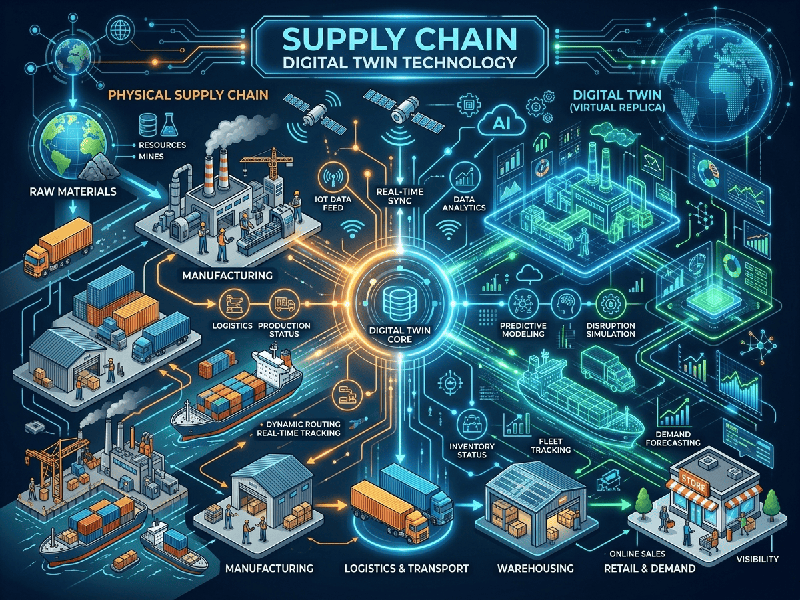
Supply Chain Digital Twin Technology
A Supply Chain Digital Twin (SCDT) is a dynamic, virtual replica of an end-to-end supply chain. Unlike a static map or spreadsheet, it integrates real-time data from across the ecosystem—including suppliers, manufacturing plants, logistics providers, and retail points—to create a living model that simulates, predicts, and optimizes operations.
1. How It Works
An SCDT functions by ingesting data from your existing
IT infrastructure (ERP, WMS, TMS, and IoT sensors) and applying advanced
analytics to visualize the current state while simulating potential
"what-if" scenarios.
The Core Components:
- Data Integration: Aggregates real-time data from
IoT devices, ERP systems, and external sources (e.g., weather, traffic,
geopolitical news).
- Simulation Engine: Uses historical data and
predictive algorithms to model future states or disruptions.
- Optimization Layer: Automatically suggests the best
course of action (e.g., rerouting a shipment due to a port strike) to
maintain efficiency and cost-effectiveness.
- Visualization Interface: Provides stakeholders with a
dashboard to monitor performance and view simulation results.
2. Key Capabilities
By building a digital replica, companies can move from
reactive troubleshooting to proactive resilience.
- End-to-End Visibility: Eliminates data silos by
creating a "single source of truth" across the entire value
chain.
- Predictive Analytics: Identifies potential
bottlenecks or risks (like component shortages) before they manifest as
supply chain failures.
- "What-If" Scenario
Planning:
Allows managers to test decisions in a sandbox environment. For example: "What
happens to our lead times if Supplier X goes bankrupt, or if we shift
production to a new regional hub?"
- Dynamic Optimization: Continually refines inventory
levels, transportation routes, and production schedules based on actual
demand rather than static forecasts.
3. Implementation Maturity
Implementing an SCDT is a journey that typically
evolves through three stages:
1.
Descriptive:
Visualizing the current supply chain structure and identifying where inventory
and products currently are.
2.
Predictive:
Using data to forecast how the supply chain will perform in the coming days or
weeks.
3.
Prescriptive:
The system automatically recommends—or executes—the best decisions to achieve
specific goals, such as maximizing profit or minimizing carbon footprint.
4. Strategic Considerations
To successfully deploy a digital twin, businesses must
focus on data quality. If the underlying data (inventory accuracy, lead
times, supplier reliability) is flawed, the twin will provide inaccurate
simulations. Start by identifying the most critical nodes of your network—where
failures are most likely or most costly—and build your digital twin around
those areas first.