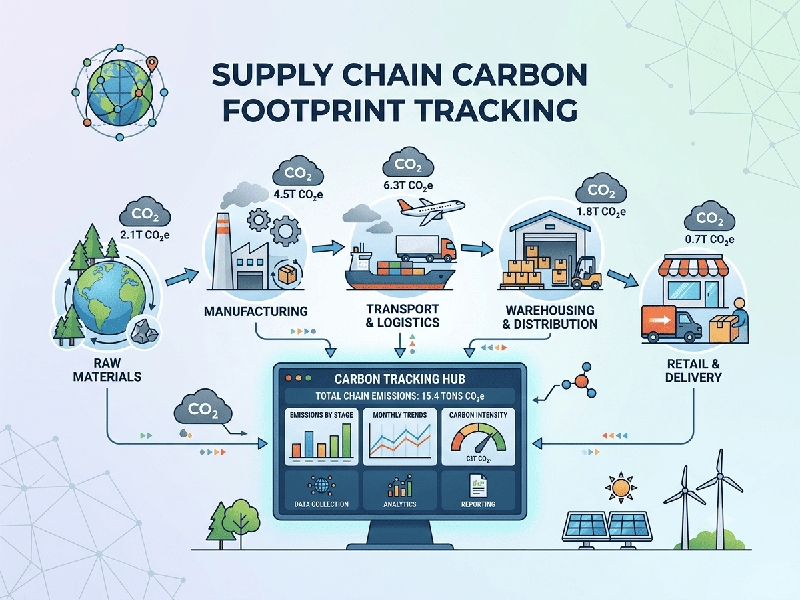
Supply Chain Carbon Footprint Tracking
Supply chain carbon footprint tracking measures the
total greenhouse gas (GHG) emissions generated across every stage of a
product's lifecycle—from raw material extraction to final delivery and
disposal.
Carbon Emission Scopes
- Scope 1 (Direct Emissions): Greenhouse gases produced
directly by company-owned assets, including manufacturing plants,
warehouses, and fleet vehicles.
- Scope 2 (Indirect Energy
Emissions): Emissions
generated from purchased electricity, steam, heating, or cooling consumed
by the organization.
- Scope 3 (Supply Chain
Emissions):
Upstream and downstream emissions across the value chain, including raw
material sourcing, contract manufacturing, third-party logistics (3PL),
business travel, and product end-of-life treatment. Scope 3 typically
accounts for over 80% of a company's total carbon impact.
Core Implementation Steps
1.
Map the Value Chain: Identify all tier-1, tier-2, and sub-tier suppliers, logistics routes,
and distribution hubs.
2.
Collect Operational Data: Transition from spend-based estimates (financial proxies) to
activity-based data (actual fuel consumption, kilowatt-hours, fuel types, and
shipment distances).
3.
Apply Emission Factors: Convert operational metrics into carbon dioxide equivalent (
4.
Audit & Report: Validate data accuracy using primary supplier audits and publish
findings via frameworks like CDP (Carbon Disclosure Project) or GRI (Global
Reporting Initiative).
Strategic Business Impact
- Regulatory Compliance: Meets mandatory disclosure laws
like the EU's Corporate Sustainability Due Diligence Directive (CSDDD) and
Carbon Border Adjustment Mechanism (CBAM).
- Cost Reduction: Pinpointing energy
inefficiencies and optimized transport routing directly cuts fuel and
operational overhead.
- Supply Chain Resilience: Enhances visibility into
supplier operations, mitigating risks related to future carbon taxes and
environmental regulations.