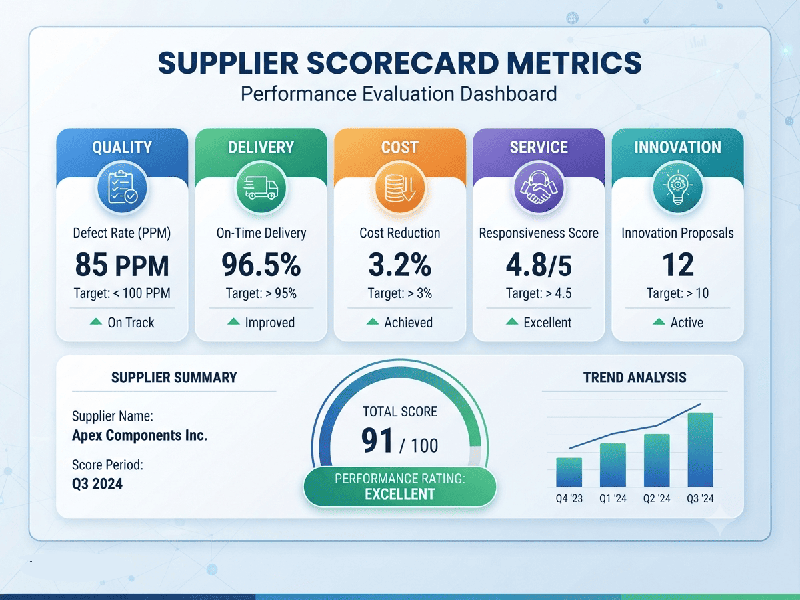
Supplier Scorecard Metrics
To effectively manage suppliers—especially in the organic food sector where quality and compliance are non-negotiable—a balanced scorecard should focus on both quantitative efficiency and qualitative reliability.
1. Quality & Compliance (The "Organic"
Standard)
For an organic food firm like Agrived Foods,
product integrity is your primary brand asset.
- Defect Rate: The percentage of shipments
that fail quality checks (e.g., contamination, spoilage, or failing
organic certification standards).
- Compliance Score: A binary or percentage-based
metric tracking adherence to organic certification renewals, food safety
audits (like FSSAI in India), and storage/transit requirements.
- First-Pass Yield: The percentage of batches that
meet all specifications on the first inspection without requiring rework
or rejection.
2. Delivery & Reliability
- OTIF (On-Time, In-Full): The gold standard for
logistics. An order is only "perfect" if it arrives on the
agreed date and in the exact quantities ordered.
- Lead-Time Variance: Measures how often the
supplier’s actual delivery time deviates from their promised lead time.
High variance is a major red flag for inventory planning.
- Order Accuracy: Frequency of incorrect items,
missing documentation (invoices, organic certs), or poor packaging that
leads to transit damage.
3. Financial Efficiency
- Total Cost of Ownership (TCO): Don't look just at the unit
price. Calculate costs including shipping, insurance, administrative time
for dispute resolution, and storage fees for early/late deliveries.
- Invoice Accuracy Rate: The percentage of invoices that
match purchase orders without requiring manual intervention or financial
adjustments.
- Claim Resolution Speed: How quickly the supplier
resolves pricing disputes or chargebacks.
4. Strategic & Risk Metrics
- Responsiveness &
Flexibility: A
qualitative score (1–5) based on how quickly the supplier adapts to sudden
demand surges or logistics disruptions.
- Sustainability Contribution: Tracking carbon footprint of
transport or the supplier’s investment in eco-friendly packaging, which
reinforces your brand’s organic promise.
- Risk Mitigation Capacity: Does the supplier have a proven
continuity plan? Evaluate this via their ability to provide alternate
logistics routes or contingency production capacity.