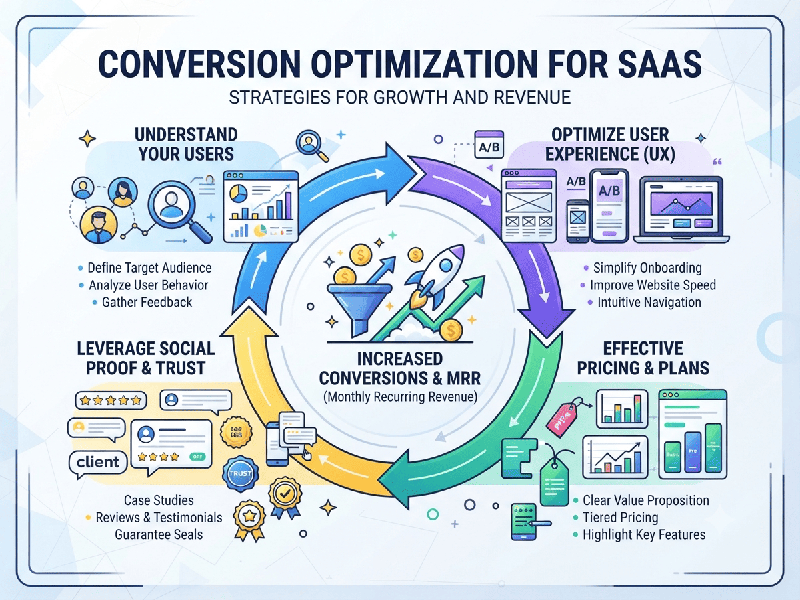
Conversion Optimization for SaaS
Conversion optimization for SaaS in 2026 is no longer
just about A/B testing button colors; it is about Time-to-Value (TTV)
and friction reduction. With the rise of AI-driven tools, users expect a
hyper-personalized experience from the moment they land on your site.
1. Radical Focus on "Time-to-Value" (TTV)
The faster a user experiences your product’s
"Aha!" moment, the higher your conversion rate.
- Interactive Onboarding: Replace static product tours
with interactive, in-app walkthroughs that prompt users to take one
meaningful action immediately.
- The "Zero-to-Value"
Audit: Identify
the exact step where a new user gets value (e.g., generating their first
report, integrating an API, or sending their first message). Remove every
mandatory field and obstacle that stands between them and that moment.
- Value-First Paywalls: Show the user the value first
(e.g., a preview of their data) before asking for the credit card.
2. Personalization via AI Segmentation
Generic landing pages are seeing diminishing returns.
Use data to tailor the narrative.
- Dynamic Content Insertion: Automatically swap landing page
headlines, hero images, and case studies based on the visitor's industry
(e.g., "SaaS Solutions for Agrived Foods" vs. "Cloud
Infrastructure for Logistics").
- Intent-Based Journeys: Use clear call-to-action (CTA)
paths. If your analytics show a visitor is looking at
"Integrations" vs. "Pricing," change the follow-up
email sequence or retargeting ad to match that specific interest.
3. Frictionless Conversion &
"Product-Led" Growth
For B2B SaaS, the sign-up process is often where
conversion dies.
- Social/SSO Sign-ups: Eliminate password creation
during initial sign-up. Support Google, Microsoft, and passkey
authentication to reduce drop-off.
- Progressive Profiling: Don't ask for a phone number,
company size, and job title on the first screen. Ask for the email first,
then gather the rest of the CRM data progressively as they use the
product.
- Self-Serve vs. Sales-Assist: Use "signal-based"
routing. High-intent traffic (e.g., pricing pages) should offer a
"Book a Demo" option, while exploratory traffic should be nudged
toward a "Free Trial" or "Freemium" model.
4. Trust and "Risk Reversal"
In 2026, buyers are more cautious about SaaS spend.
You must actively neutralize objections.
- Evidence-Based Social Proof: Move beyond generic
testimonials. Use "results-based" proof (e.g., "Agrived
Foods reduced supply chain latency by 22% using [Product Name]").
- Transparent ROI: Incorporate an ROI calculator
directly on the pricing page. Let users adjust sliders to see potential
cost savings or efficiency gains in their local currency (e.g., using the ₹
symbol for Indian market context).
- Security Trust Signals: Highlight certifications (ISO,
SOC2, GDPR compliance) prominently near the sign-up button.