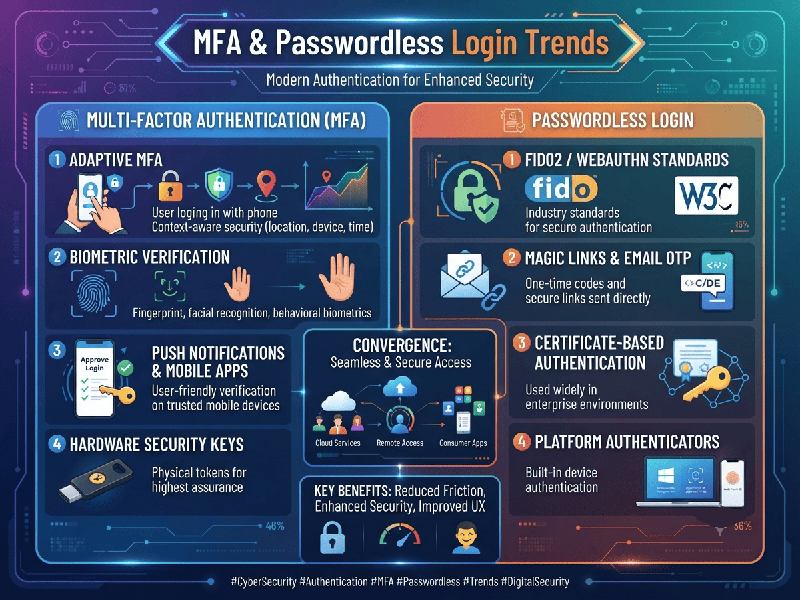
MFA & Passwordless Login Trends
The landscape of authentication has shifted from
"bolted-on" security to an identity-first approach. The primary
transition is the move away from shared secrets (passwords) toward
cryptographic, phishing-resistant methods.
Below are the key trends defining authentication and
identity management this year.
1. The Rise of the "Passkey-First" Default
Passkeys (based on FIDO2/WebAuthn standards) have
moved from an early-adopter niche to the industry standard.
- Default Status: New applications are now being
built with passkey-first user experiences, replacing passwords entirely
during onboarding.
- Phishing Resistance: Because they rely on public-key
cryptography bound to a specific origin, they cannot be phished or
intercepted, even if a user visits a malicious site.
- Cross-Device Maturity: Apple, Google, and Microsoft
have matured their implementations, making syncing passkeys across devices
reliable and seamless for the average user.
2. Intelligent, Adaptive Authentication
Rather than applying a static "second
factor" to every login, modern systems now use Adaptive Authentication
driven by AI.
- Risk-Based Signals: Authentication requirements
scale dynamically based on real-time data: IP reputation, geolocation,
time of access, and device posture.
- Frictionless UX: If the login context is
"known" (e.g., your usual laptop, at your home office, during
work hours), the system allows seamless entry. If the risk score spikes,
the system automatically triggers a step-up challenge.
3. Continuous Authentication & Behavioral
Biometrics
The industry is moving beyond "one-and-done"
login checks to continuous validation.
- Behavioral Signatures: Systems monitor how a user
interacts with their device—typing cadence, mouse movement patterns, and
touchscreen gestures.
- Session Security: If behavioral patterns change
drastically during an active session (suggesting a possible account
takeover), the system can force immediate re-authentication.
4. Non-Human Identity (NHI) Management
As AI agents and automated services proliferate, the
sheer volume of "machine identities" (API keys, service accounts,
workload identities) has outpaced human accounts.
- Governance Shift: In 2026, IAM (Identity and
Access Management) strategies are prioritizing the inventory and rotation
of these machine identities to prevent them from becoming
"shadow" attack vectors.
- Agentic AI Governance: Organizations are implementing
specific controls to manage how "agentic" AI can authenticate
and act on behalf of a human user.
5. Regulatory Pressure & Digital Identity
Governments worldwide are mandating higher standards
for authentication to combat the surge in credential-based fraud.
- Regulatory Compliance: New mandates—such as the EU’s
eIDAS 2.0 and regional data privacy acts (like the DPDPA in India)—are
making phishing-resistant authentication (AAL2-compliant) a legal
requirement rather than a best practice.
Digital IDs: Government-backed portable digital identities (like mobile driver's licenses) are gaining mainstream adoption, setting a blueprint for how businesses should handle identity verification and onboarding.