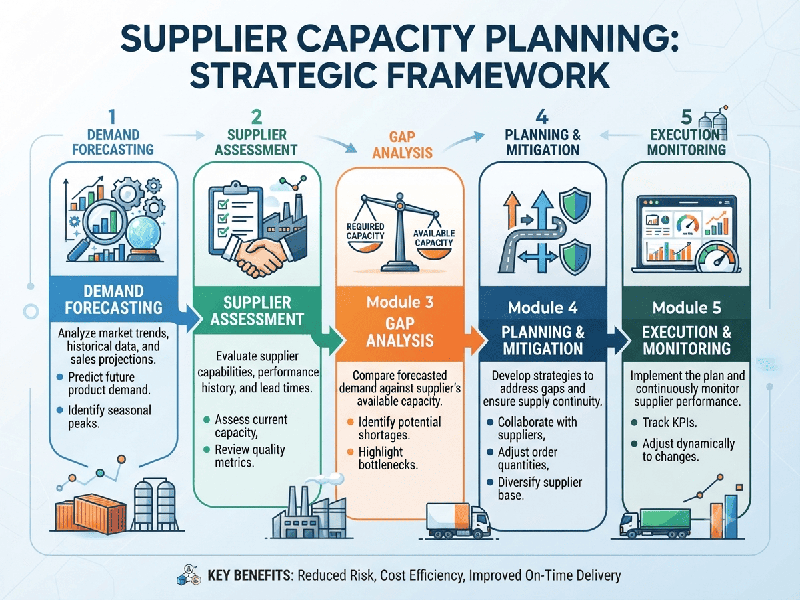
Supplier Capacity Planning
Supplier capacity planning ensures that your suppliers
have the production capabilities, labor, materials, and machinery needed to
meet your demand without causing bottlenecks, stockouts, or expensive rush
orders.
1. Core Dimensions of Supplier Capacity
To evaluate a supplier effectively, you must analyze
three distinct layers of their operational capacity:
- Design Capacity: The maximum theoretical output
a supplier’s facility can achieve under ideal, uninterrupted conditions.
- Effective Capacity: The realistic output accounting
for regular maintenance, shift changes, worker breaks, and typical setup
times (usually 75–85% of design capacity).
- Actual (Realized) Capacity: The true output achieved under
current operational constraints, worker absenteeism, or raw material
shortages.
2. Step-by-Step Capacity Planning Process
A structured workflow helps align your demand
forecasts with your suppliers' production schedules:
- Demand Forecasting &
Sharing: Share
rolling 3-to-12-month demand forecasts with your suppliers early.
Transparency allows them to secure raw materials and schedule labor shifts
in advance.
- Gap Analysis: Compare your forecasted
requirements against the supplier’s effective capacity. Identify
potential shortfalls well before peak seasons or major product launches.
- Buffer & Safety Stock
Strategy:
Establish an agreed-upon buffer stock or vendor-managed inventory (VMI)
agreement to absorb minor demand spikes or sudden supply chain
disruptions.
- Continuous Monitoring &
KPIs: Track key
performance indicators (KPIs) such as Capacity Utilization Rate, On-Time
In-Full (OTIF) delivery, and Order Lead Time to spot capacity
constraints early.
3. Mitigation & Risk Management Strategies
Relying on a single supplier for critical components
leaves your operations vulnerable to capacity crunches. Mitigate risks using
these tactics:
- Dual or Multi-Sourcing: Split your order allocation
among multiple suppliers (e.g., 70% primary, 30% secondary) to ensure
backup capacity is instantly accessible.
- Capacity Reservations: Negotiate capacity-reservation
contracts (or take-or-pay contracts) where you pay a small fee to
guarantee a fixed percentage of a supplier's machine time or output
volume.
- Technology Integration: Connect your Enterprise
Resource Planning (ERP) or Supply Chain Management (SCM) systems directly
with key suppliers via APIs or EDI for real-time visibility into inventory
and production status.