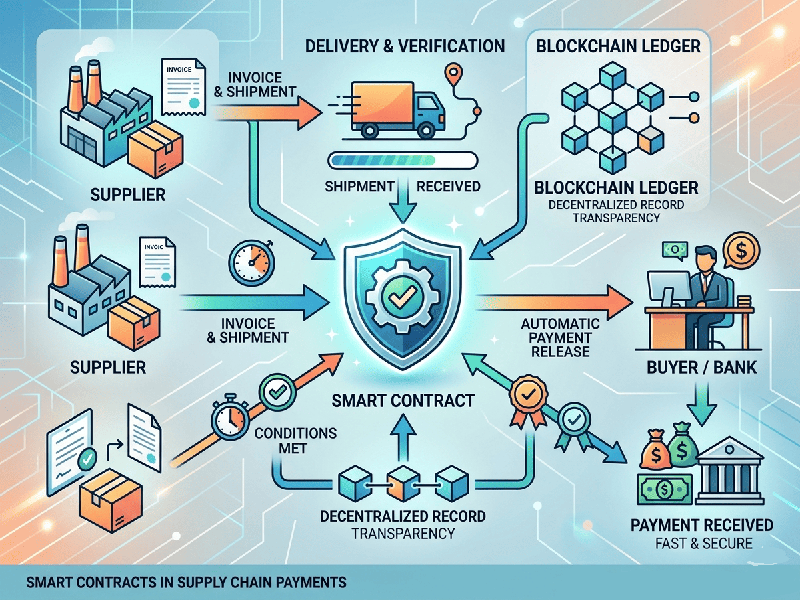
Smart Contracts in Supply Chain Payments
Integrating smart contracts into supply chain payments
addresses one of the oldest friction points in global trade: the trust gap
between buyers and sellers.
Traditionally, suppliers wait 30, 60, or even 90 days to
receive payment after delivering goods, tied up in manual invoice verification,
bank clearing, and disputes. Smart contracts eliminate this lag by turning
legal and operational agreements into self-executing code.
1. How the Smart Contract Payment Flow Works
Unlike traditional workflows where payment is triggered
manually by an accounting team, a smart contract relies on digital, verifiable
triggers (oracles or data inputs) to move funds automatically.
1.
Escrow Setup: The
buyer and supplier agree to terms (e.g., price, delivery timeline, quality
metrics). The buyer deposits the agreed-upon funds into the smart contract's
digital escrow.
2.
Data Ingestion (Oracles): The contract listens for physical world triggers via APIs or
IoT sensors.
3.
Instant Settlement: The moment the delivery conditions are checked and verified as true, the
smart contract instantly releases the payment to the supplier's digital wallet.
2. Core Benefits for Enterprises
- Elimination of Counterparty
Risk: Suppliers
don't have to worry if the buyer will pay them post-delivery, and buyers
don't have to worry about paying for goods that never arrive. The funds
are locked and guaranteed.
- Near-Zero Settlement Delay: Traditional cross-border B2B
wire transfers take 3 to 5 business days and incur heavy intermediary bank
fees. Smart contracts can settle payments in minutes using stablecoins or
central bank digital currencies (CBDCs).
- Dynamic, Conditional Pricing: Payments can automatically
adjust based on SLA performance. For example, if an agriculture supplier's
cold-chain IoT logs show a container exceeded a specific temperature
limit, the smart contract can automatically apply a pre-agreed 10% penalty
deduction before releasing the remaining funds.