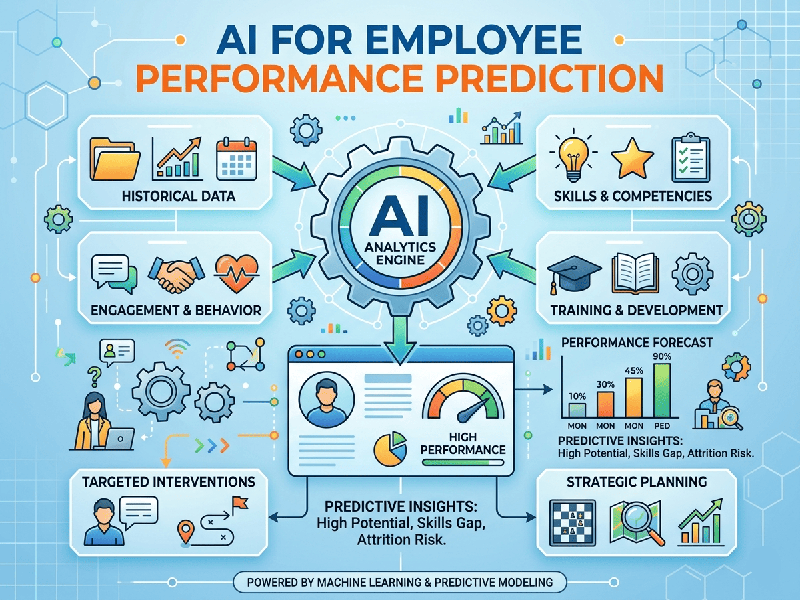
AI for Employee Performance Prediction
The way companies track and evaluate how people work is
undergoing a major shift. Relying on an annual review—which is often prone to
human memory lapses or personal bias—is being replaced by predictive AI that
tracks and forecasts employee outcomes in real time.
Using AI to predict employee performance is transforming how
HR teams approach talent management. Instead of just looking backward at annual
reviews, predictive AI analyzes historical and real-time data to forecast
future productivity, flight risk, and leadership potential.
Core Data Inputs
To make accurate predictions, the AI ingests data from
multiple enterprise systems, balancing quantitative output with qualitative
indicators.
- Core HRIS Data: Tenure, role history,
compensation trajectory, promotion cycles, and past performance review
ratings.
- Activity & Productivity
Metrics: Code
commits (for developers), ticket resolution times (for support), sales
pipeline velocity (for sales), or project milestone completion rates in
ERP/project management tools.
- Collaboration & Engagement: Evaluation of digital
touchpoints (e.g., response times, meeting frequencies, and
cross-departmental collaboration patterns) to gauge engagement without
infringing on privacy.
- Skill & Learning Data: Completion rates of upskilling
programs, certifications achieved, and internal assessment scores.
Technical Architecture & Workflow
An enterprise-grade performance prediction engine typically
follows a four-step pipeline to turn raw data into actionable management
insights.
1.Data Ingestion & Integration:
Securely syncs data across various enterprise platforms
(HRIS, CRM, ERP, and communication tools) via encrypted APIs.
2.Feature Engineering & Anonymization:Step 2.
Cleans the data, handles missing values, and masks personally
identifiable information (PII) to ensure compliance and reduce algorithmic
bias.
3.Predictive Modeling:
Runs machine learning models (typically Random Forests,
Gradient Boosting, or specialized neural networks) trained on historical
company data to identify patterns that correlate with high performance or
burnout.
4.Actionable Insights Output:
Delivers risk scores, potential high-performer alerts, and
tailored training recommendations directly to HR dashboards and management
portals.