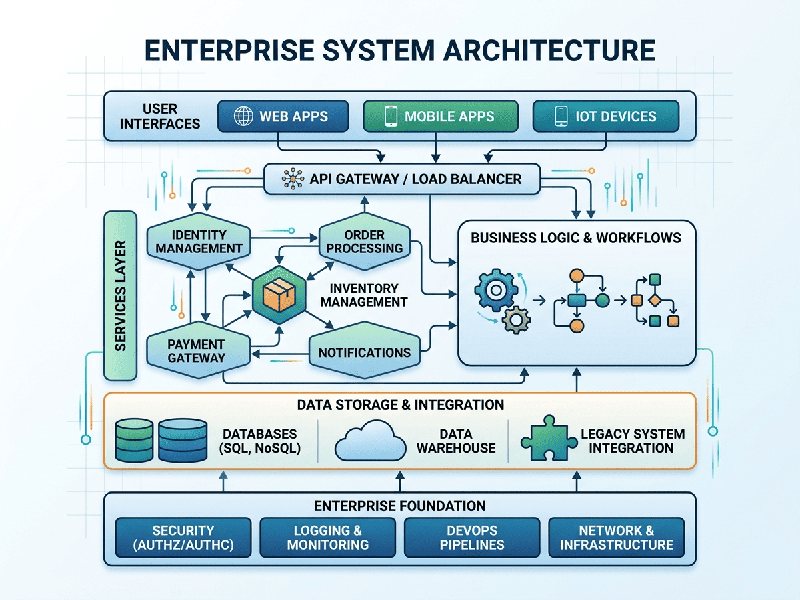
Design System Architecture for Enterprises
Designing a system architecture for an enterprise isn't just
about picking the right tech stack; it’s about building a blueprint that can
handle massive scale, organizational silos, legacy systems, and strict security
requirements.
1. Core Structural Layers
A modern enterprise architecture typically separates concerns
into distinct, decoupled layers. This ensures that a failure in one layer
doesn’t bring down the entire ecosystem.
- API Gateway Layer: The single entry point for all
clients. It handles cross-cutting concerns like OAuth2/OIDC
authentication, rate limiting, and request routing.
- Microservices / Domain-Driven
Design: The
business logic is split into loosely coupled services aligned with
business domains (e.g., Billing, Identity, Inventory).
- Data Tier Separation: Enterprises must split
transactional databases (OLTP) used for daily operations from
analytical databases (OLAP/Data Lakes) used for reporting to
prevent performance bottlenecks.
2. Key Pillars of Enterprise Architecture
When designing at this level, you have to architect for
failure. These four pillars keep the enterprise stable:
High Availability & Fault Tolerance
- Multi-Region Deployment: Active-Active or Active-Passive
setups across geographical regions to ensure 99.99% or 99.999% uptime (the
"four or five nines").
- Circuit Breakers: If a non-critical downstream
service (like a recommendation engine) fails, the system trips a circuit
breaker to stop making calls to it, allowing the main application to keep
running smoothly.
Zero Trust Security Architecture
- Never Trust, Always Verify: Assume threats exist both
inside and outside the network. Every request must be authenticated,
authorized, and encrypted in transit (using mTLS) and at rest.
- Identity Governance: Centralized Identity and Access
Management (IAM) paired with Role-Based Access Control (RBAC).
Performance & Scalability
- Event-Driven Architecture (EDA): Utilizing message brokers like
Apache Kafka or AWS Kinesis for asynchronous communication. This prevents
synchronous HTTP chain bottlenecks.
- Multi-Tier Caching: Utilizing edge caching (CDNs),
distributed caching (Redis) for session/database queries, and in-memory
application caching.