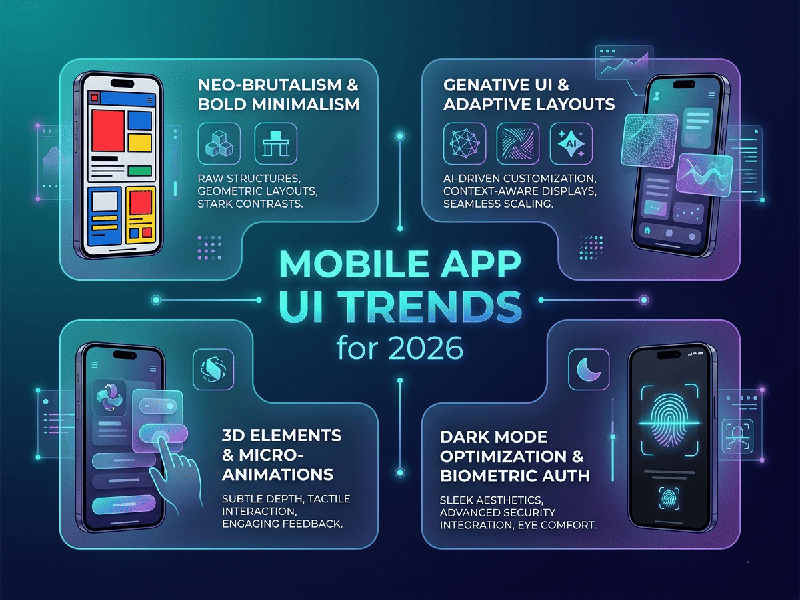
Mobile App UI Trends for 2026
Mobile application UI design focuses less on flashy visual
gimmicks and more on contextual maturity, friction reduction, and
accessibility. With advanced hardware, improved on-device processing, and
the deep integration of AI, interfaces have become hyper-personalized, fluid,
and highly intentional.
1. Top UI Design Trends
AI-Driven Adaptive UIs (Beyond Basic Recommendations)
Personalization no longer means a simple "Recommended
for You" section. App interfaces actively morph their layouts, reorder
navigation menus, and prioritize specific feature cards based on real-time user
behavior, location, and intent.
- Two users opening the exact same
app can see entirely unique screens tailored to how they interact with the
platform.
Bento Grid Layouts with Functional Depth
Inspired by physical bento boxes, this layout structure
segments information into neat, asymmetrical grids. It helps present complex,
multi-variable data without overwhelming the user.
- To add dimension, designers mix
flat grid aesthetics with modern skeuomorphism—using soft shadows,
progressive blurs, and glassmorphic materials to establish clear spatial
hierarchy.
Zero-Click Navigation & Predictive Surfaces
The ultimate goal is eliminating digital friction. Apps use
predictive analytics to surface context-aware actions exactly when a user needs
them, drastically reducing the number of necessary taps.
- For instance, a delivery or
logistics dashboard will automatically elevate transit milestones, gate
passes, or instant payment options right to the primary screen based on
time and proximity.
Purposeful Micro-interactions & Kinetic Motion
Animations have transitioned from visual decoration into
critical structural communication. Micro-interactions—like subtle haptic
feedback patterns or buttons that softly shift states—provide immediate,
satisfying confirmation of user actions.