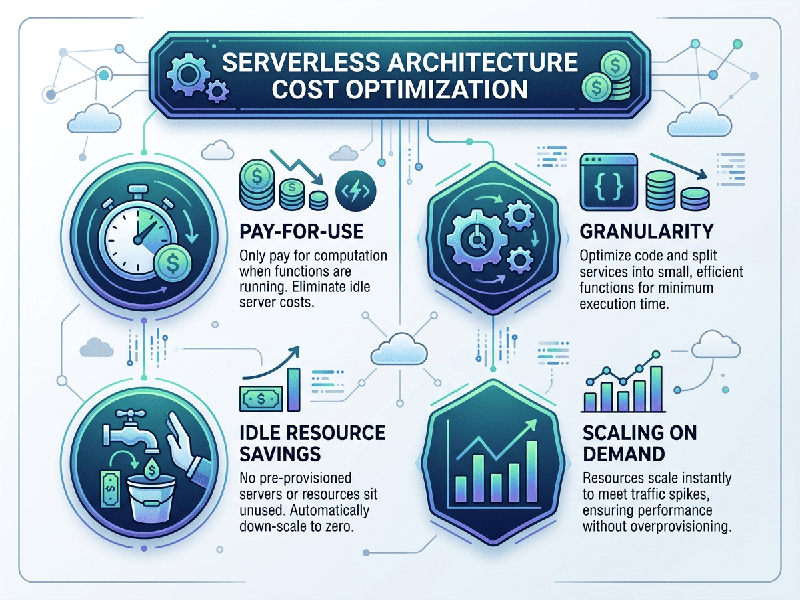
Serverless Architecture Cost Optimization
Optimizing costs in a serverless environment requires a shift
from managing "servers" to managing execution efficiency.
Because serverless billing is granular (often calculated by the millisecond),
small inefficiencies in code or architecture can lead to significant "bill
shock."
Here is how to optimize serverless costs in 2026:
1. Fine-Tune Memory and Execution Time
Serverless providers typically charge based on Memory
allocated × Duration.
- The Sweet Spot: Increasing memory doesn't
always increase cost. Since higher memory also grants more CPU power, a
task might finish twice as fast with double the memory, resulting in the
same total cost but better performance.
- Avoid Over-allocation: Use tools like AWS Compute
Optimizer or GCP Recommender to find the "Goldilocks"
memory setting for each function.
2. Combat the "Synchronous Call Trap"
One of the most expensive mistakes in serverless is having
one function wait for another.
- The Problem: If Function A calls Function B
and waits for a response, you are paying for Function A to sit idle.
- The Fix: Use Asynchronous patterns.
Trigger downstream processes via message queues (SQS, Pub/Sub) or event
buses (EventBridge).
3. Manage "Cold Starts" Without Overpaying
Cold starts cause latency, but the common fix—Provisioned
Concurrency—can be a cost trap because it reinstates a flat hourly fee,
breaking the "pay-as-you-go" model.
- Lightweight Runtimes: Switch from heavy runtimes
(Java, .NET) to lightweight ones (Python, Node.js, or Go) to reduce
initialization time naturally.
- Bundle Optimization: Tree-shake your code to remove
unused libraries. Smaller deployment packages load faster, reducing the
duration of the cold start.
4. Implement Smart Data Tiering and Egress Control
Data movement is often the "hidden" cost of
serverless.
- Locality: Keep your serverless functions
and your data (S3, DynamoDB, Cloud Storage) in the same region to
avoid egress charges.
- Lifecycle Policies: Automatically move logs and
older files from high-performance storage to "Cold" tiers (like
S3 Glacier) after 30 days.
5. Prevent "Recursive Loop" Disasters
A bug that causes a function to trigger itself can rack up
thousands of ₹ in hours.
- Safety Valves: Always set Reserved
Concurrency limits on new or experimental functions. If a loop occurs,
it will be throttled before it drains your budget.
- Monitoring: Set up billing alarms that
trigger if daily spend exceeds 110% of the forecast.