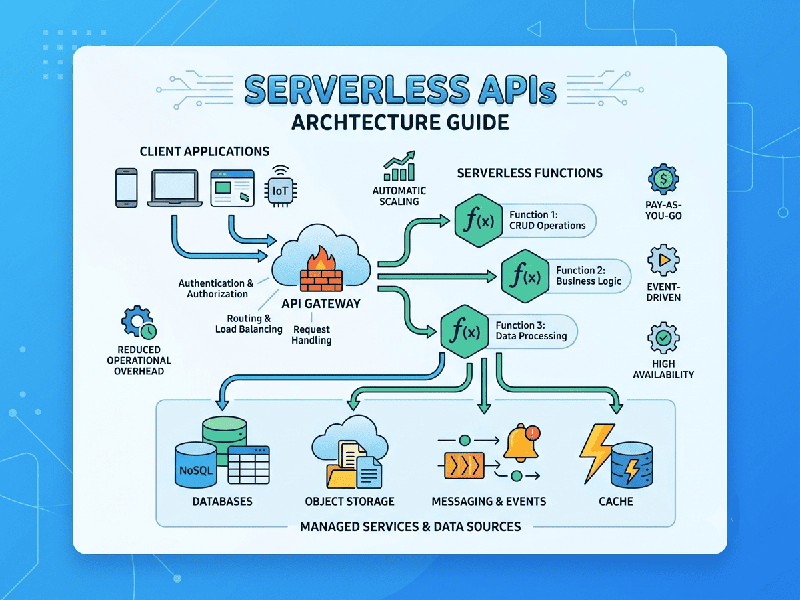
Serverless APIs: Architecture Guide
A Serverless API Architecture delegates server
management, provisioning, and auto-scaling to cloud providers. You pay strictly
per invocation and compute time rather than for idle server capacity.
Core Components of a Serverless API
- API Gateway (Routing &
Auth): Receives
HTTP/HTTPS requests, handles rate limiting, authenticates users (e.g.,
JWT, OAuth), and routes requests to the corresponding function. (Examples:
AWS API Gateway, Azure API Management, Cloudflare Workers).
- Compute / FaaS (Business Logic): Stateless, event-driven
functions that execute code in response to API requests and scale down to
zero when idle. (Examples: AWS Lambda, Azure Functions, Google Cloud
Functions).
- Database (Data Layer): On-demand, auto-scaling
datastores optimized for high concurrency. (Examples: DynamoDB, Aurora
Serverless, MongoDB Atlas, PlanetScale).
- Identity Provider
(Authentication): Offloads user identity, tokens, and authorization. (Examples:
AWS Cognito, Auth0, Firebase Auth).
- Asynchronous Queues / Event Bus
(Decoupling):
Handles long-running or background tasks to keep API response times fast. (Examples:
AWS SQS/EventBridge, GCP Pub/Sub).
Standard Architecture Flow
1.
Client Request:
The client makes a REST or GraphQL request.
2.
Gateway Verification: The API Gateway validates tokens/keys, applies rate limits, and maps the
request payload.
3.
Function Invocation: The Gateway triggers a stateless compute function (FaaS).
4.
Data Operations: The function executes business logic, queries/updates the serverless
database, or pushes heavy background jobs to an asynchronous queue.
5.
Response Return: The function sends the JSON response back through the Gateway to the
client, terminating the function execution.
Common Architectural Patterns
- Direct Integration (CRUD): Client -> API Gateway ->
Lambda -> DynamoDB
- Asynchronous / Decoupled: Client -> API Gateway ->
SQS Queue -> Lambda -> Database (Best for heavy tasks to avoid API
timeouts).
- Edge-First API: Client -> Cloudflare Workers
/ AWS CloudFront Functions (Executes code at CDN edge nodes close to the
user for minimal latency).