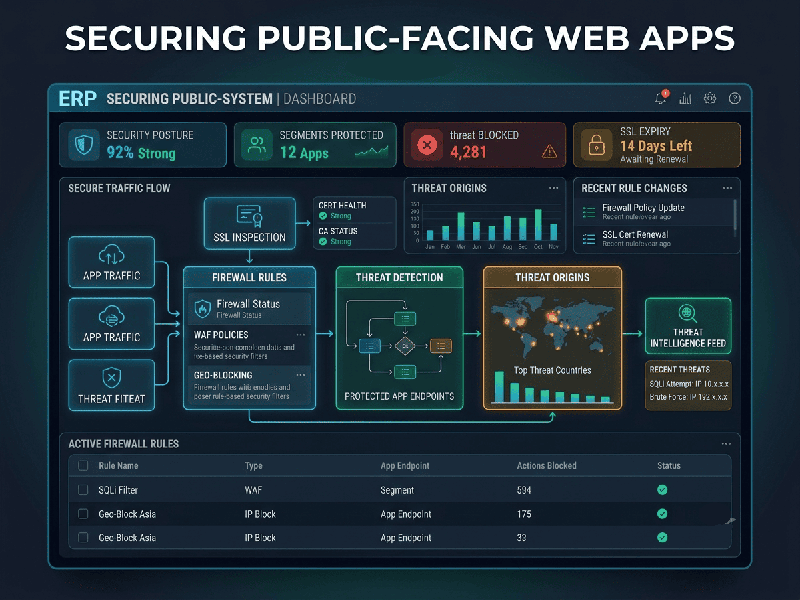
Securing Public-Facing Web Apps
Securing public-facing web applications requires a comprehensive,
defense-in-depth strategy. Because these applications are exposed directly to
the open internet, they are constant targets for automated bots, credential
stuffers, vulnerability scanners, and malicious actors.
Effective security spans the network edge, application
logic, data handling, and infrastructure layers.
1. Core Pillars of Web Application Security
A. Edge Protection & Infrastructure Defense
Web Application Firewall (WAF): Inspects incoming HTTP/HTTPS traffic
to filter out common web exploits such as SQL injection (SQLi), Cross-Site
Scripting (XSS), and malicious payloads before they hit your application
servers.
DDoS Mitigation: Utilizes services (like Cloudflare, AWS Shield, or
Google Cloud Armor) to absorb volumetric and application-layer DDoS attacks
without disrupting legitimate users.
Advanced Bot Management: Deploys behavioral analysis or
challenge-response tests (like CAPTCHA / Turnstile) to block credential
stuffing, web scraping, and automated checkout abuse.
B. Robust Authentication & Session Management
Multi-Factor Authentication (MFA): Mandatory for administrative access
and strongly recommended for end users, especially during high-risk actions
(e.g., password changes or financial transfers).
Secure Credential Handling: Never store plaintext passwords. Use
modern cryptographic hashing algorithms like Argon2id or bcrypt
equipped with unique salts.
Secure Session Handling: Store sensitive tokens in HTTP-only,
Secure, SameSite cookies rather than local storage to protect against XSS
token theft. Implement short token lifespans combined with secure refresh token
rotation.
C. Input Validation & Injection Prevention
Parameterized Queries / ORMs: Prevent SQL injection entirely by
separating SQL code from user-supplied parameters using prepared statements or
Object-Relational Mappings.
Strict Payload Validation: Implement robust input validation
(using libraries like Zod, Joi, or built-in schema validators) on both
client and server sides to verify data types, lengths, and formats.
Output Encoding: Automatically encode dynamic output rendered in the
browser to neutralize Cross-Site Scripting (XSS) attacks.
D. Security Headers & Browser Hardening
Proper HTTP response headers prevent browsers from
executing malicious scripts or leaking data:
Content Security Policy (CSP): Restricts domains from which
scripts, styles, and images can be loaded, mitigating XSS and data injection
impacts.
HTTP Strict Transport Security (HSTS): Forces browsers to interact with the
application solely over encrypted HTTPS connections.
X-Frame-Options / Frame-Ancestors: Prevents clickjacking by controlling
whether your site can be embedded inside an <iframe>.
E. Secrets & Configuration Hygiene
Environment Variables: Strictly separate configuration from
code. Never hardcode database credentials, private keys, or API secrets into
source repositories.
Dedicated Secret Managers: Utilize secure storage vaults (such
as HashiCorp Vault, AWS Secrets Manager, or GitHub encrypted secrets) to inject
secrets dynamically during runtime or deployment.
3. Key Vulnerabilities to Mitigate (OWASP Top 10
Focus)
Broken Access Control: Ensure users can only access
resources and endpoints matching their explicit authorization level (use
role-based access control [RBAC] and attribute-based checks).
Security Misconfigurations: Disable default accounts, turn off
verbose debugging/error stack traces in production environments, and remove
unused services.
Cryptographic Failures: Enforce TLS 1.3 encryption in
transit and AES-256 encryption for sensitive data at rest.