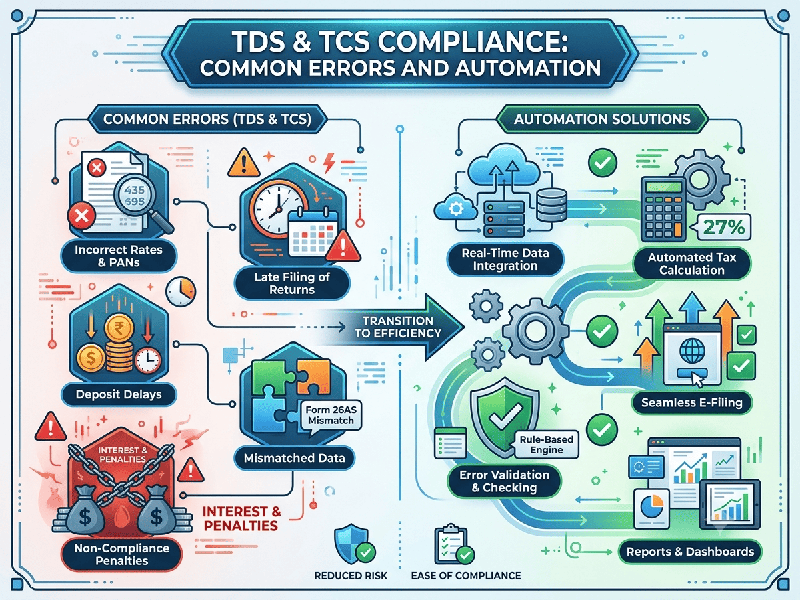
TDS and TCS Compliance: Common Errors and Automation
Managing TDS (Tax Deducted at Source) and TCS
(Tax Collected at Source) compliance involves precise calculation, timely
payment, and accurate return filing. Under modern tax administration systems,
automated reconciliation and cross-module tracking directly flag discrepancies.
1. Common Errors in TDS & TCS Compliance
A. Data Entry & Identification Errors
Incorrect PAN/TAN Entry or Invalid PAN Status: Entering an incorrect PAN or missing
an inoperative/specified non-filer PAN triggers higher tax rates (e.g., Section
206AA / Section 206AB).
Section Misclassification: Deducting tax under the wrong
section code (e.g., classifying professional fees under Section 194C
[contractor] instead of Section 194J [technical/professional fees]) causes
short-deduction notices and interest liabilities.
Failure to Identify TCS Transactions: Missing TCS applicability on
specific transactions (e.g., foreign remittances under LRS, sale of motor
vehicles above thresholds, or sale of goods under Section 206C(1H)).
B. Timing & Rate Mismatches
Short Deduction / Collection: Applying outdated tax rates, missing
surcharges, or ignoring revised statutory threshold limits.
Late Deduction or Collection: Deducting tax at the time of payment
instead of credit (or whichever occurs earlier), leading to mandatory interest
charges.
Delayed Tax Deposits: Failing to deposit
collected/deducted tax into the central account by the monthly due date
(generally the 7th of the following month), incurring interest under Section
201(1A).
C. Filing & Reconciliation Issues
Challan & OLTAS Mismatches: Errors in quoting the BSR code,
challan serial number, or deposit date in quarterly returns, which prevents tax
credits from reflecting in Form 26AS/AIS.
Delayed / Non-Filing of Returns: Missing quarterly filing deadlines
for TDS (Forms 24Q, 26Q, 27Q) or TCS (Form 27EQ), which triggers automatic late
fees under Section 234E and penalties under Section 271H.
GST vs. TDS Data Discrepancy: Differences between outward sales
reported in GST returns and sales/purchases tagged for TCS or TDS.
Non-Issuance of Certificates: Delays in issuing Form 16 / 16A
(TDS) or Form 27D (TCS) within mandated timelines.
2. Automation in TDS & TCS Compliance
Automating the tax compliance workflow minimizes human
error, ensures timely filings, and maintains clean audit trails.
Real-Time Vendor & Customer Validation: Software tools auto-verify PAN
status via Income Tax / NSDL databases upon vendor onboarding to determine
whether standard or higher tax rates apply.
Automated Rate & Rule Engines: Enterprise systems auto-assign
correct section tags (194C, 194J, 194Q, 206C, etc.) based on chart-of-accounts
mapping and line-item thresholds.
Challan Sync & Reconciliation: Direct portal integration matches
ERP deduction entries with OLTAS challan receipts automatically, highlighting
unconsumed or incorrectly mapped challans.
Validation Utility Alignment: Automated compliance software
continuously syncs with the latest File Validation Utility (FVU) schemas from
the tax department to prevent upload rejections.
Bulk Certificate Download & Delivery: TRACES portal integration allows
finance teams to generate, digitally sign, and email Form 16A / Form 27D
certificates in bulk.
Compliance Dashboard & Reminders: Automated calendars alert finance
teams to upcoming deposit dates (7th of every month) and quarterly return
deadlines to avoid late filing fees.
3. Best Practices Checklist for Finance Teams
Verify at Entry: Validate PAN/TAN details automatically during ERP
invoice booking.
Monthly Ledger Audit: Reconcile TDS/TCS ledger balances
against challan deposits before initiating return uploads.
Cross-Check GST: Periodically cross-reconcile turnover declared in
GSTR-1/3B with TCS collected and TDS (194Q) deducted.
Maintain Rules Library: Ensure your ERP software is updated
to reflect tax amendments and updated threshold limits.