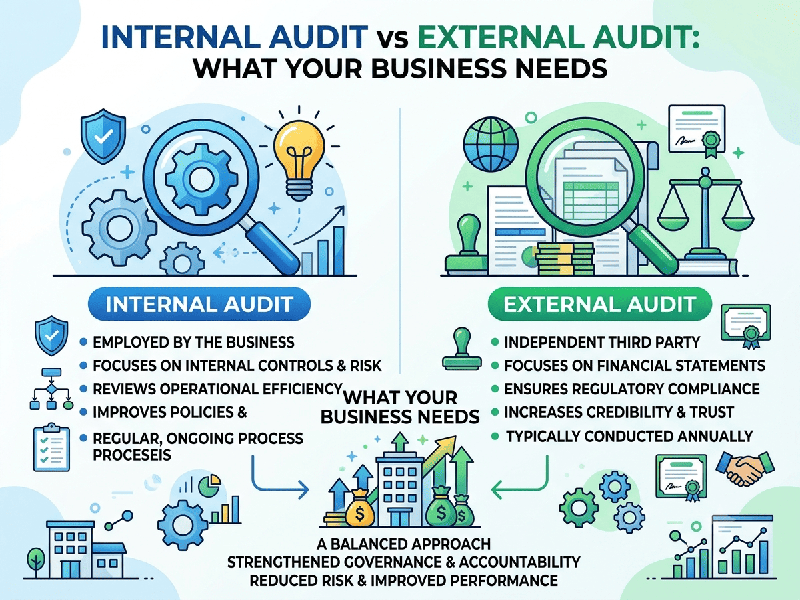
Internal Audit vs External Audit: What Your Business Needs
Both internal and external audits serve essential
corporate governance functions, but they operate with distinct objectives,
scopes, reporting structures, and regulatory mandates.
Key Roles & Responsibilities
Internal Audit: Operational Efficiency & Risk
Mitigation
Internal Control Evaluation: Assesses whether financial,
operational, and IT controls are designed effectively and operating as
intended.
Operational & Process Audits: Identifies bottlenecks, wasteful
practices, and inefficiencies across departments (procurement, HR, supply
chain).
Regulatory & Policy Compliance: Ensures the organization adheres to
local laws, industry regulations, and internal company policies.
Fraud Prevention & Risk Oversight: Detects control gaps that could
expose the organization to fraud, cybersecurity threats, or compliance
breaches.
External Audit: Financial Accuracy & Compliance
Verification
Financial Statement Examination: Audits balance sheets, income
statements, cash flows, and notes to accounts for compliance with accounting
standards (e.g., Ind AS, IFRS, US GAAP).
Statutory Compliance: Ensures the enterprise complies with
statutory reporting deadlines, tax filings, and company law disclosures.
Opinion Issuance: Issues an independent auditor's report
(Unmodified/Clean, Qualified, Adverse, or Disclaimer of Opinion).
Material Discrepancy Detection: Uncovers material misstatements or
non-compliance issues affecting financial integrity.
Early-Stage / Small Businesses:
Need: External Audit (or standard accounting reviews) to
fulfill basic statutory compliance, annual filing requirements, or lender
conditions. Internal audit is often handled informally through strong
owner/management oversight.
Mid-Market & Rapidly Growing Companies:
Need: Both. As operational complexity and headcount expand,
management can no longer oversee every process. An Internal Auditor
fixes broken processes and controls before the External Auditor arrives
to verify the financial statements.
Enterprise & Listed Corporations:
Need: Both (Mandatory). Regulators, stock exchanges, and
corporate governance codes mandate independent external financial audits
alongside an established internal audit department or outsourced internal audit
partner.