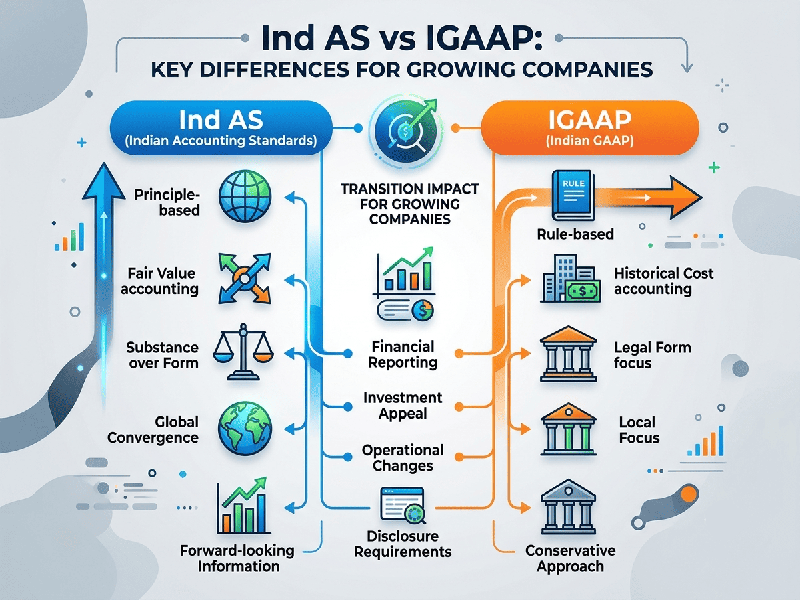
Ind AS vs IGAAP: Key Differences for Growing Companies
Transitioning from IGAAP (Indian GAAP / Accounting
Standards) to Ind AS (Indian Accounting Standards, converged with IFRS)
is a critical milestone for growing Indian companies. While IGAAP focuses
heavily on historical cost and legal form, Ind AS emphasizes fair value,
substance over form, and global comparability.
1. Why the Shift Matters for Growing Companies
A. Impact on Financial Metrics & Valuations
EBITDA Fluctuations: Capitalizing leases under Ind AS 116 shifts operating
lease expenses from rent (EBITDA item) to depreciation and interest,
artificially boosting EBITDA while increasing debt on the balance sheet.
Earnings Volatility: Mark-to-market accounting for investments and
financial instruments introduces fair value gains or losses directly into the
profit and loss statement or Other Comprehensive Income (OCI).
B. Investor Readiness & Global Capital Access
Cross-Border Transparency: Because Ind AS is aligned with
International Financial Reporting Standards (IFRS), foreign institutional
investors (FIIs), private equity (PE) firms, and global lenders can read and
audit financial statements without complex reconciliation adjustments.
Due Diligence Speed: Clean, Ind AS-compliant financials streamline
institutional funding rounds, mergers and acquisitions (M&A), and IPO
preparations.
C. System & Operational Overhaul
ERP and Data Demands: Systems like SAP or Microsoft
Dynamics must be reconfigured to track fair values, discount rates for leases,
and historical collection trends for ECL models.
Upfront Costs: Engaging valuation experts for fair-valuation of property,
plant, equipment, and financial instruments requires dedicated budgeting and
project planning.
3. Applicability: When Does a Company Need to Switch?
Ind AS applicability is phased based on Net Worth
and Listing Status:
Voluntary Adoption: Any company can voluntarily adopt Ind AS, setting a
precedent for institutional readiness.
Mandatory Adoption (Corporate Sector):
Listed or unlisted companies with a net worth of ₹500
crore or more are mandated to comply.
Listed companies with a net worth of less than ₹500
crore (along with their holding, subsidiary, joint venture, and associate
companies) must adopt Ind AS in subsequent phases.