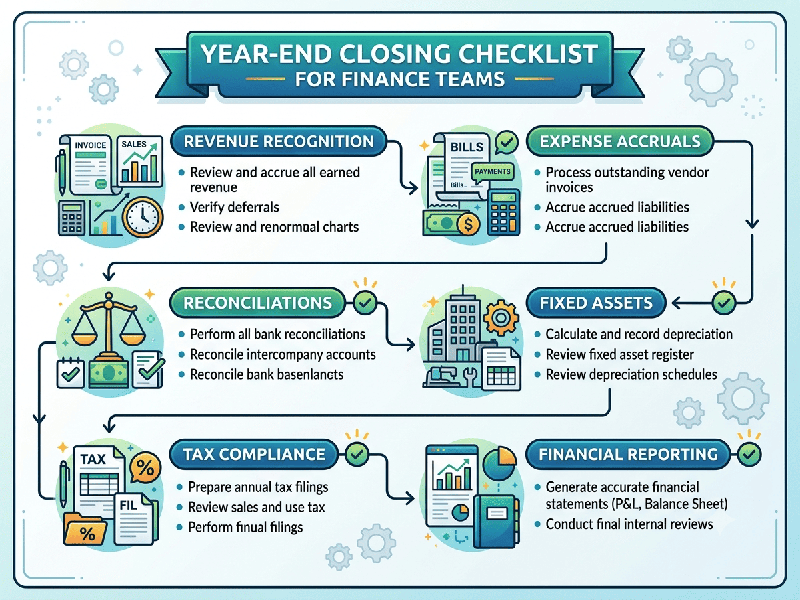
Year-End Closing Checklist for Finance Teams
Executing a seamless year-end financial close requires
a structured approach across multiple operational phases. This checklist
outlines the essential steps finance teams must undertake to ensure statutory
compliance, ledger accuracy, and audit readiness.
Phase 1: Pre-Close Preparations & Timeline
Alignment
Establish the Closing Calendar: Publish a strict milestone schedule
defining cut-off dates for accounts payable, accounts receivable, payroll
adjustments, and inventory counts.
Review Accounting Policies & Standards: Verify alignment with applicable
accounting frameworks (e.g., Ind AS, IFRS, or US GAAP) regarding revenue
recognition, lease accounting, and asset impairment guidelines.
Schedule Audit Pre-Clearance: Coordinate with internal and
external auditors to agree on confirmation formats, sampling timelines, and
scheduled interim review dates.
Phase 2: Balance Sheet Reconciliation & Sub-Ledger
Verification
Cash and Bank Reconciliations:
Reconcile all operational, payroll, and sweep bank
accounts against general ledger balances.
Investigate and clear old outstanding checks or
un-reconciled deposits.
Accounts Receivable (AR) & Aging Analysis:
Review the AR aging report to identify overdue
balances and assess doubtful accounts.
Adjust the provision for expected credit losses (ECL)
or bad debt reserves.
Ensure all credit memos, rebates, and discounts have
been properly accounted for.
Accounts Payable (AP) & Accrued Expenses:
Perform a thorough search for unrecorded liabilities
by reviewing goods received not invoiced (GRNI) reports.
Accrue for utility, legal, audit, and professional
services incurred before year-end but not yet billed.
Inventory Valuation & Physical Count:
Conduct a year-end physical inventory count across
warehouses and transit hubs.
Adjust ledger balances for shrinkage, damage, and
obsolescence based on valuation policies (FIFO/Weighted Average).
Fixed Assets & Depreciation:
Capitalize qualifying work-in-progress (WIP) projects
completed during the year.
Run depreciation and amortization calculations for
tangible and intangible assets.
Perform fixed asset physical verification and document
asset retirements or disposals.
Prepaid Expenses & Deferred Revenue:
Amortize prepaid expenses (such as insurance, software
subscriptions, and annual maintenance contracts).
Review deferred revenue schedules to ensure proper
recognition matching performance obligations.
Phase 3: Tax Compliance & Statutory
Reconciliations
Tax Reconciliation:
Reconcile income tax expense, current tax liabilities,
and deferred tax assets/liabilities.
Review transfer pricing documentation and intercompany
agreements if applicable.
Indirect Tax & GST Reconciliation:
Reconcile annual outward and inward supplies against
periodic returns (e.g., GSTR-1, GSTR-3B vs. GSTR-2B matching).
Ensure timely reversal of Input Tax Credit (ITC) on
exempt supplies, blocked credits, or payments delayed beyond statutory limits.
Withholding Tax & Regulatory Filings:
Verify tax deducted at source (TDS/withholding) ledger
balances against quarterly statutory returns.
Issue annual withholding certificates to vendors and
employees.
Phase 4: P&L Review, Adjusting Entries &
Intercompany Eliminations
Intercompany Reconciliations:
Match intercompany balances, loans, management fees,
and trade transactions across group entities.
Post matching elimination entries to remove
intercompany profits and unrealized margins.
Foreign Currency Revaluation:
Revalue foreign currency monetary assets and
liabilities (bank accounts, receivables, payables, loans) using closing
exchange rates.
Post unrealized exchange gain or loss adjustments to
the income statement.
Accrual & Adjusting Journal Entries:
Review recurring journal entries, prepayments, and
accrual schedules for accuracy.
Obtain formal management sign-offs and documentation
for all manual or non-standard journal entries.
Analytical Review of P&L:
Perform variance analysis comparing actual performance
against budgets, forecasts, and prior-year figures.
Investigate material anomalies or unexpected
fluctuations in operating expenses and gross margins.
Phase 5: Financial Statement Finalization & Audit
Handover
Financial Statement Drafting:
Prepare complete financial statements, including the
Balance Sheet, Statement of Profit and Loss, Cash Flow Statement, Statement of
Changes in Equity, and detailed notes to accounts.
Management Representation & Sign-Offs:
Compile the final closing package and secure executive
sign-offs (CFO and CEO).
Prepare the Management Representation Letter for
external auditors.
Ledger Lock & Rollover:
Lock the financial periods for the closing fiscal year
in the ERP system to prevent unauthorized postings.
Open the new fiscal year periods and carry forward
opening balances.