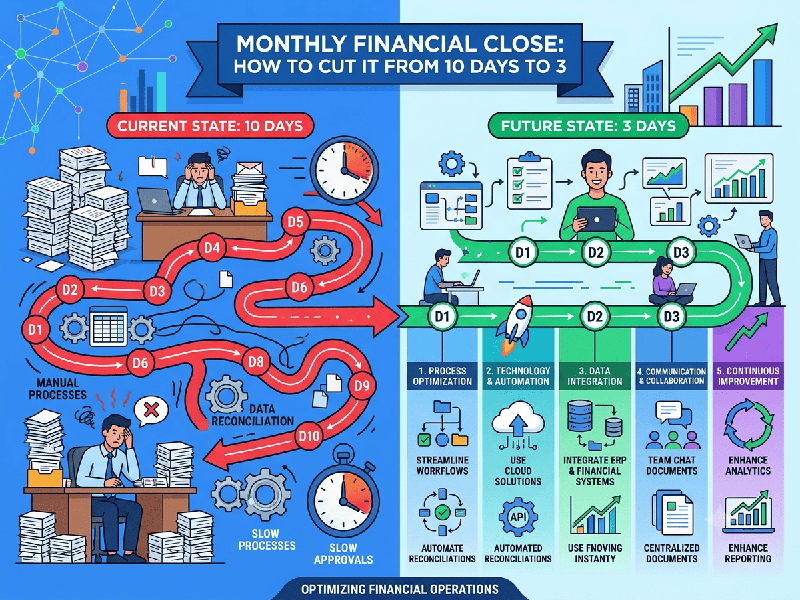
Monthly Financial Close: How to Cut It from 10 Days to 3
Reducing a monthly close cycle from 10 days to 3
requires moving away from sequential, manual workflows to parallel processing,
automation, and continuous accounting.
Phase 1: Operational Restructuring (Days -5 to Day 0)
Implement Continuous Accounting:
Perform high-volume tasks daily or weekly rather than
saving them for month-end (e.g., bank reconciliations, credit card clearing,
intercompany matching).
Resolve sub-ledger discrepancies throughout the month
to eliminate period-end discovery delays.
Establish Rigid Cut-Off Rules:
Enforce strict cut-off dates for accounts payable
invoices (e.g., day -2 before month-end). Invoices received after the cut-off
move to the following month or receive an automated system accrual.
Freeze master data additions (new GL accounts, cost
centers, vendor setups) 5 business days before month-end.
Phase 2: Execution by Day Breakdown
Day 1: Sub-Ledger Close & Automated Feeds
Automation Targets: Sub-ledger locks, automated bank feeds, recurring
journals.
Key Steps:
Automatically close Accounts Payable (AP) and Accounts
Receivable (AR) sub-ledgers by 12:00 PM.
Run automated bank reconciliation rules to match
standard receipts and disbursements.
Post system-generated recurring journal entries
(depreciation, amortization, standard prepayments).
Day 2: Reconciliations, Intercompany & Accruals
Automation Targets: Automated accrual engines, intercompany elimination
modules.
Key Steps:
Post automated accruals based on open Purchase Orders
(POs) and Goods Received Not Invoiced (GRNI) reports.
Execute automated intercompany matching and post
balance eliminations across group entities.
Reconcile remaining complex balance sheet accounts
using standardized reconciliation templates.
Day 3: P&L Review, Final Adjustments &
Reporting
Automation Targets: Real-time financial statement generation, variance
analysis dashboards.
Key Steps:
Run automated financial statement consolidation
(Income Statement, Balance Sheet, Cash Flow).
Conduct targeted variance analysis (Actual vs. Budget
/ Prior Period) using pre-built dashboard flags.
Lock the General Ledger (GL) period for posting and
distribute reporting packages to management.
Phase 3: Enablers of a 3-Day Close
Materiality Thresholds: Increase accrual materiality
thresholds. Avoid spending time calculating minor $100–$500 accruals that have
no material impact on financial performance.
ERP & Integration Tooling: Utilize ERP automation features or
specialized close management software to track tasks in real time and
automatically trigger dependent steps.
Standardized Templates: Eliminate customized ad-hoc
spreadsheets. Mandate uniform journal entry and reconciliation formats across
all business units.